


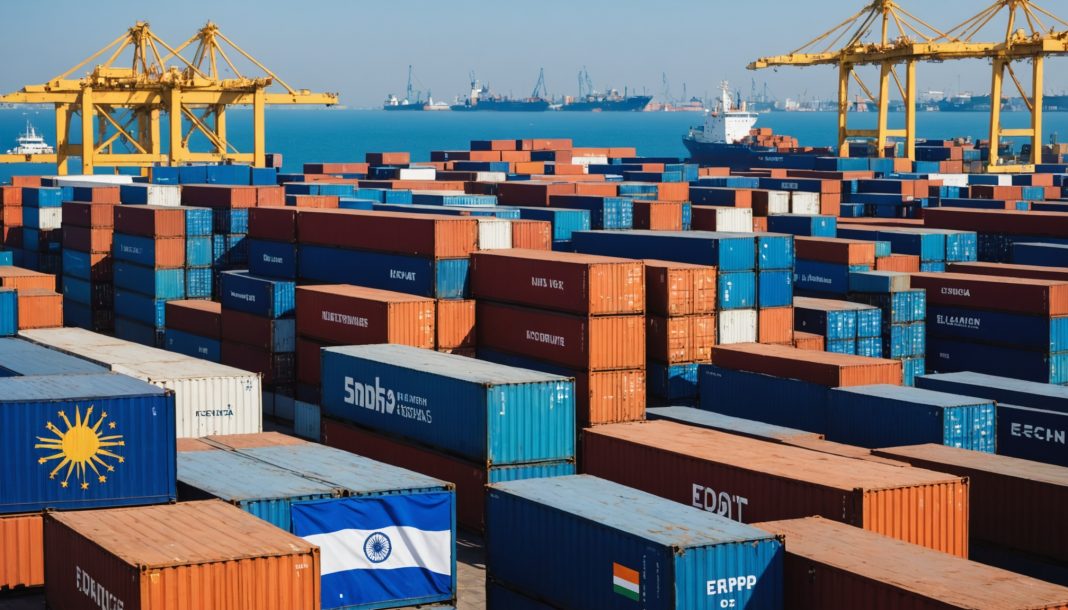
After nearly twenty years of negotiations, the free trade agreement between India and the European Union is now official. Signed on January 27, 2026, in New Delhi, the agreement creates the largest free trade zone ever negotiated by Brussels, affecting nearly 2 billion consumers on both sides. Here's a breakdown of the concrete changes ahead.
A deal sealed after two decades of deadlock
Talks between the two economic powers began in the mid-2000s, before repeatedly stalling over sensitive issues such as automobiles and intellectual property. The signing on January 27, 2026, attended by European Council President António Costa, European Commission President Ursula von der Leyen, and Indian Prime Minister Narendra Modi, marks the culmination of this long-running diplomatic effort. The text's final ratification and legal signature are expected by the end of 2026, with entry into force anticipated in 2027.
Tariffs lowered across several industries
In practical terms, the agreement calls for a gradual reduction of tariffs on more than 90% of goods exported between the two zones. Several sectors are directly affected:
- Automobiles, with Indian tariffs cut from 110% to 10% for a quota of 250,000 vehicles per year;
- Industrial machinery, where 44% taxes will be largely eliminated;
- Chemicals, with a gradual phase-out of 22% tariffs;
- Pharmaceutical products, where 11% taxes will largely disappear;
- Wine and spirits, whose export taxation will also be lowered.
According to European Commission projections, this trade opening could generate up to €4 billion in annual savings for European companies, while aiming to double trade between the two zones in the years ahead.
A less contested agreement than the one with Mercosur
Unlike the EU-Mercosur agreement, which has drawn strong opposition from several European agricultural sectors, the text negotiated with India excludes sensitive products such as beef, sugar, and rice. This exclusion partly explains the more favorable reception of the agreement among member states. Beyond the trade component, Brussels and New Delhi also signed a security and defense partnership covering cybersecurity, counterterrorism, maritime piracy, and space cooperation.
What this means for businesses and consumers
For European exporting companies, lower tariff barriers open access to one of the world's most dynamic markets, with India's middle class growing rapidly. For Indian consumers, the agreement promises easier access to European products that were previously burdened by high taxes, particularly in the automotive and pharmaceutical sectors. Conversely, certain Indian industrial sectors could gain greater access to the European market once the measures are fully implemented.
Frequently Asked Questions
When will the agreement actually enter into force?
The political signing took place on January 27, 2026, but final legal ratification is expected by the end of 2026, with effective implementation anticipated in 2027.
Which products are excluded from the agreement?
The most sensitive agricultural products, such as beef, sugar, and rice, are not covered by the tariff reductions, unlike in the EU-Mercosur agreement.
Which sectors benefit most from the tariff cuts?
Automobiles, industrial machinery, chemicals, and pharmaceuticals are among the industries seeing the steepest tariff reductions, with rates sometimes cut by a factor of ten.
This agreement is part of a broader economic landscape, shaped by regulatory shifts and new dynamics in global trade. To follow the concrete impact of these agreements on businesses, check out our Business – Companies section, as well as our analyses in Finance – Economy and Law and Justice.
Sources
This article was written with the help of artificial intelligence. Editorial policy

