


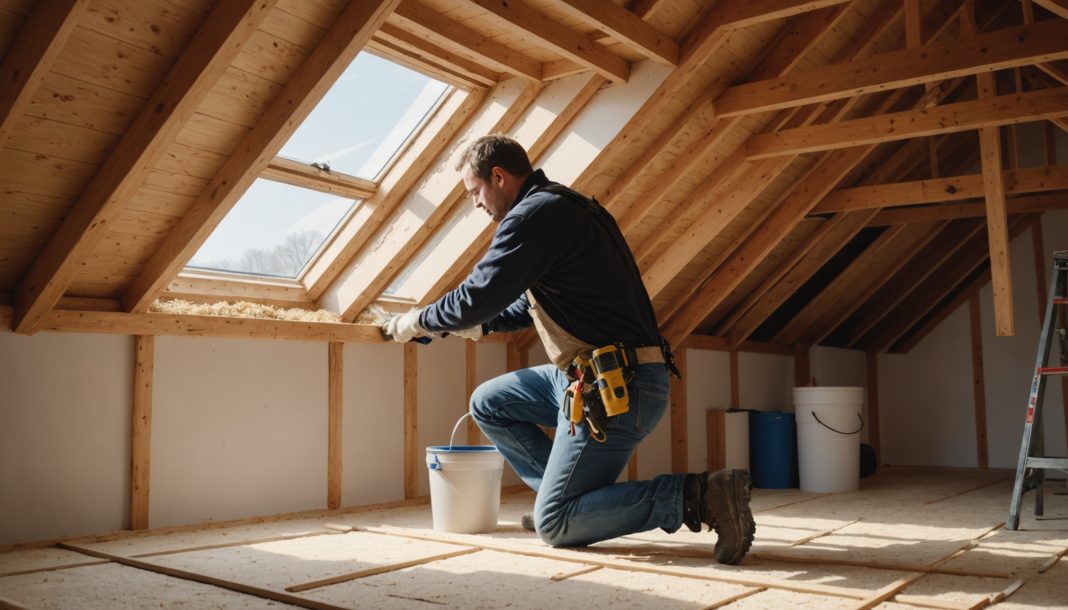
Before starting an attic insulation project, it's worth knowing the available techniques, the thermal resistance to target, and the financial assistance you can tap into: the roof is the biggest source of heat loss in a poorly insulated home, and a botched insulation job shows up on the heating bill every winter.
Unfinished or Finished Attics: Two Projects, Two Techniques
The method depends on the type of attic. For unfinished attics (non-habitable), the most common technique is to blow loose-fill mineral wool or cellulose wadding onto the floor using a machine: for an average home, the job can be wrapped up in just a few hours. For finished attics, or attics being converted, semi-rigid panels of rock wool or wood fiber are installed under the roof, between rafters or roof trusses—a longer and more technical job. To compare materials before deciding, The Home Depot's dedicated attic insulation page offers an initial benchmark for prices and products available in stores.
The project also involves the roof frame and covering: as our article on a well-insulated roof points out, the condition of the roof covering and attic insulation are inseparable when it comes to durably limiting heat loss.
What Thermal Resistance Should You Aim For?
The regulatory threshold for qualifying for financial assistance is set at a thermal resistance R of at least 7 m².K/W for unfinished attics, compared with 6 m².K/W for the sloped sections of finished attics. In practice, it's best to aim higher: increasing to 10 m².K/W, or about 40 cm of blown insulation, costs almost nothing extra in labor, since machine application takes barely any longer for a few additional centimeters. It's often the best value for comfort on the whole project.
Available Financial Assistance
Several programs can reduce the bill: MaPrimeRénov' for owner-occupants or landlords of a home over 15 years old using a certified RGE (Reconnu Garant de l'Environnement) contractor, the CEE bonus (certificats d'économies d'énergie, or energy-savings certificates), the reduced 5.5% VAT rate on the work, or the zero-interest eco-loan to spread out the cost. Eligibility conditions and application channels change regularly from one year to the next: it's best to check your project's exact eligibility before signing a quote, and to request a detailed quote from several RGE-certified contractors to compare services and prices per square meter.
The Mistakes That Cost You
- Choosing insulation based on price alone, without considering its thermal resistance or acoustic performance.
- Compressing the insulation to fit it into too narrow a space: compacted mineral wool loses up to 30% of its thermal resistance.
- Neglecting ventilation: a home made too airtight without a functioning mechanical ventilation system (VMC) traps moisture under the roof, risking mold.
- Insulating without addressing noise when the attic becomes a living space: additional treatment, using suitable acoustic plasters and coatings, prevents unpleasant surprises once a bedroom or home office is set up under the roof.
As with any project involving the roof frame and covering, the safety measures specific to renovation work fully apply: working at height or in cramped attic spaces is not something to improvise, even for an experienced do-it-yourselfer.
Frequently Asked Questions
Should unfinished or finished attics be insulated first?
Unfinished attics, since the job is faster and less costly per square meter; it's also often the biggest source of heat loss when they aren't insulated at all.
Can you insulate your own unfinished attic?
Blowing loose-fill wool is doable with a rented machine for a knowledgeable do-it-yourselfer, but hiring a certified RGE contractor remains necessary to qualify for financial assistance.
How long does an attic insulation project take?
For blown insulation in unfinished attics, a few hours are enough for an average home; for finished attics with semi-rigid panels, expect anywhere from one to several days depending on the surface area to be treated.
Sources
- 2026 Aid Guide from Anah (the French national housing agency)
- Recommended thermal resistance for attics
- MaPrimeRénov' conditions for attic insulation
This article was written with the help of artificial intelligence. Editorial policy

