


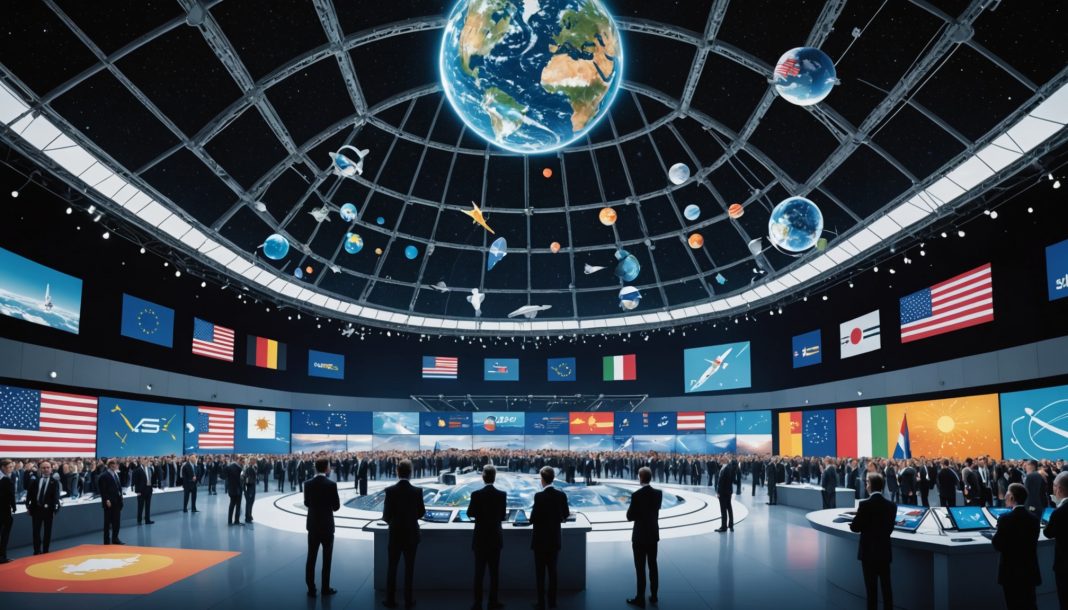
From September 9 to 10, Paris will host an unprecedented international space summit at the Grand Palais, bringing together heads of state, space agencies, scientists, astronauts, and private sector representatives around a shared observation: Earth's orbit, long seen as limitless territory, is becoming a crowded space that now needs to be managed collectively.
An Unprecedented Global Gathering at the Grand Palais
Driven by French diplomacy, the event aims to bring together a range of stakeholders rarely seen on the same stage: governments, space agencies, international and regional organizations, development banks, local authorities, and civil society. The stated goal is not to sign a binding treaty in two days, but to open a permanent space for dialogue on the technical challenges posed by the explosion of orbital traffic. A topic that, until now, remained largely confined to expert circles is now taking on a fully diplomatic dimension.
The choice of digital technology as a backdrop is no accident: the satellites currently crowding low Earth orbit are, first and foremost, connectivity, observation, and navigation infrastructure on which entire sectors of the global economy depend.
Earth's Orbit, an Increasingly Crowded Space
In just a few years, the number of active satellites has multiplied several times over, driven by megaconstellations designed to provide internet access from space. This densification raises three concrete problems that the Paris summit intends to put on the table:
- Orbital congestion caused by the proliferation of satellite megaconstellations;
- The increasingly contested sharing of the radio frequencies needed for space communications;
- The management of space debris, whose accumulation threatens the safety of crewed and automated missions.
These issues are nothing new for the scientific community: they were already on the agenda at the 46th international scientific assembly held in Florence earlier this summer. But with new state and private players entering the launch market, such as the recent launch into orbit of a private Indian rocket, the issue of space traffic can no longer be handled by a single country or a single agency.
A Space Diplomacy Carried by Familiar Figures
To embody this initiative, France has appointed two special envoys tasked with carrying the issue onto the international stage: former astronaut Thomas Pesquet and Hélène Huby, a well-known figure in Europe's “new space” sector. Their presence is meant to translate often complex technical issues into a message that both the general public and policymakers can understand.
This effort is part of a broader movement to seek shared frameworks on a global scale, comparable to what was recently seen when the United Nations called for international rules governing new sensitive technologies. In both cases, the observation is the same: technical innovation is moving faster than the legal frameworks meant to keep pace with it.
Toward a Framework of Shared Rules?
It remains to be seen whether this summit will lead to concrete commitments or remain simply a discussion forum. The organizers emphasize the need to involve, from the dialogue phase onward, stakeholders who do not always have a voice in traditional space negotiations: lawmakers, local governments, and civil society representatives. This is a way of broadening a debate long reserved for the historic space powers alone, at a time when orbital pollution is also starting to draw the attention of environmental advocates, now concerned about what some experts are already calling “orbital pollution.”
The Paris gathering in September is thus shaping up as a full-scale test: a test of the international community's ability to agree on common traffic rules before the congestion of orbit becomes an irreversible problem.
Frequently Asked Questions
When and where is the Paris space summit being held?
The summit is scheduled for September 9 and 10 at the Grand Palais in Paris, and is expected to bring together delegations from around the world.
Why is the congestion of Earth's orbit a problem?
The proliferation of satellites, particularly through megaconstellations, increases the risk of collisions, complicates the sharing of radio frequencies, and increases the volume of space debris in orbit.
Who is representing France at this summit?
Two special envoys have been appointed to carry France's case: former astronaut Thomas Pesquet and Hélène Huby, a well-known entrepreneur in the European space sector.
Sources
- Arkcity — International Space Summit 2026: Why Paris Wants to Bring the World Together Around Orbit
- France Diplomatie — Bilateral Relations in the Space Sector
- Sénat — Legislative File on the France / European Space Agency Agreement
This article was written with the help of artificial intelligence. Editorial policy

