


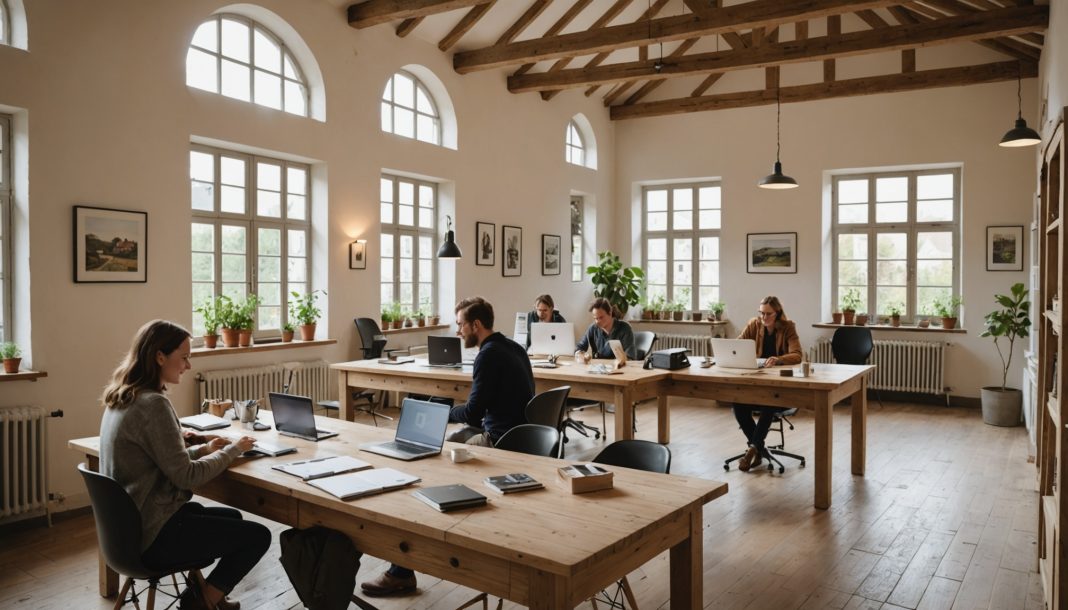
In France, the map of local services is no longer limited to the village bakery or the post office on the corner. Over the past decade, another network has quietly taken shape: that of third places, hybrid spaces that combine coworking, workshops, training, and community life under one roof. The 2026 national census, conducted by the Observatoire des Tiers-Lieux (France's national third-places observatory), now counts more than 4,000 of them across the country—a figure that is quietly reshaping the face of many villages and small towns.
A Network That Has More Than Doubled in Eight Years
The growth is striking. France had about 1,800 third places in 2018, then 3,500 in 2023. The latest count puts the number at nearly 4,050. Notably, these facilities are no longer concentrated in major metropolitan areas. 35% are located in rural areas, and 21% in small towns or mid-sized urban areas—precisely where shops and public service counters have declined the most in recent decades.
Much More Than Shared Offices
The image of a simple coworking space for urban freelancers no longer holds. A third place offers an average of nine different activities:
- 71% organize training courses or educational activities;
- 70% host cultural or artistic programming;
- 59% offer shared workspaces (coworking);
- 44% have a manufacturing workshop or production space (fab lab).
Like rural train stations converted into community hubs, many of these third places repurpose old buildings that had lost their original function: a disused factory, a closed school, a rectory, or an old barn. A second life that, in the process, gives residents a physical landmark again.
A Business Model Balanced on a Knife's Edge
These spaces now represent more than 16,400 jobs (about 12,000 full-time equivalents) and generate combined revenue close to €440 million, averaging €108,000 per facility. They rely on a community of 900,000 members and 170,000 volunteers, and 71% of them operate as nonprofit associations. Funding, however, remains fragile: 55% of resources come from the facilities' own activities, compared with 45% from public support. This dependency is flagged as a central issue by the ISBL Institute (which specializes in the study of French nonprofit organizations), which analyzed the census: these facilities provide significant local social value, but their financial viability remains closely tied to budget decisions made by local authorities and the state.
A Concrete Answer to Rural Isolation
According to a survey reported by the Banque des Territoires (the French public bank for local and regional development), 75% of local elected officials believe that third places help combat isolation and strengthen social ties in their communities. This role echoes that of other established initiatives, such as France Services centers, France's one-stop government service points, or village cafés converted into local services: in both cases, the goal is to bring together several reasons to keep living in the village under one roof, rather than centralizing everything in the city.
Frequently Asked Questions
What exactly is a third place?
It is a shared space open to the public that combines several functions: work (coworking), manufacturing (fab lab), training, culture, and community life. It is most often run by an association or a citizen collective, with strong roots in its local area.
Are third places mainly found in urban areas?
No—in fact, the opposite is true: more than half of the third places counted in 2026 are located in rural areas or in small and mid-sized towns, far from the major metropolitan areas that drove most of the movement in its early days.
Does a third place replace a shop or a public service?
No, it is meant to complement them. A third place does not replace a bakery or a government service counter, but it can host a public service office, a digital access point, or a workshop, pooling a single location to meet several everyday needs.
Sources
- Observatoire des Tiers-Lieux — 2026 National Census
- Banque des Territoires — Localtis
- ISBL Institute — Analysis of the 2026 Census
This article was written with the help of artificial intelligence. Editorial policy

