


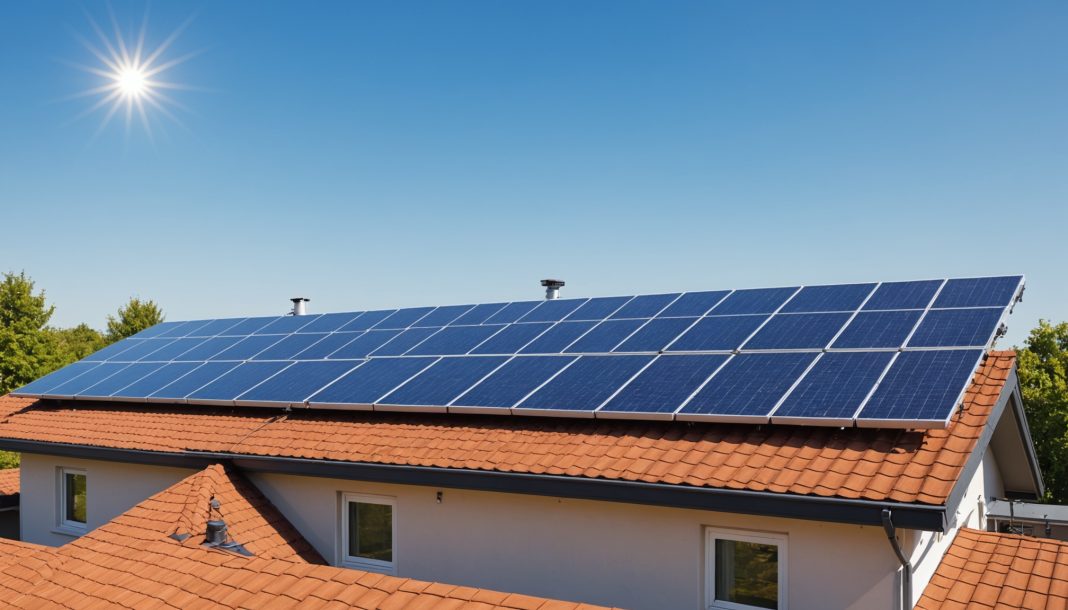
Installing solar panels on your roof is no longer a project reserved for a handful of eco-conscious enthusiasts: more and more homeowners are looking into it to cut their electricity bills and increase the value of their homes. But between the technical criteria, the incentives that keep changing, and the choice of equipment, it's easy to make a mistake. Here are the points to check before you get started.
Orientation and Tilt: The Benchmarks to Know
An installation's output depends first on its exposure to the sun. In the Northern Hemisphere, due-south orientation remains the benchmark: it corresponds to a 100% output. A southeast or southwest orientation retains about 95% of the potential, while east or west exposure drops to around 80%. As for tilt, the optimal angle is between 30° and 35° from horizontal on a yearly average, with seasonal variations: steeper in winter, flatter in summer. An RGE-certified professional should be able to simulate the expected output based on the exact configuration of the roof.
To get a sense of the options available on the market, a specialized site such as a1solarstore.com, which offers solar panels for sale, lets you compare wattages, dimensions, and prices before requesting a quote.
Self-Consumption and Resale: What Changed in 2026
The financial framework has shifted recently. Since October 1, 2025, installations with an output of 9 kWp or less have benefited from a reduced 5.5% VAT rate on equipment and installation, compared with higher rates previously applied depending on output. However, a decree that took effect on June 5, 2026 eliminated the self-consumption bonus for new applications and lowered the rate at which EDF OA (the French utility's dedicated purchasing arm) buys back surplus electricity, now set at 1.1 euro cents per kWh (down from 4 cents), a rate reassessed upward by 2% each year for 20 years. In other words, relying on direct self-consumption — using your own electricity rather than selling it — has become more advantageous than selling all of it back.
Insulation and Roofing: Work Not to Overlook
Installing panels on a poorly insulated or aging roof is a common mistake. Before any installation, it's best to check the condition of the roof covering and, if needed, carry out insulation work: a well-insulated roof limits heat loss and avoids having to remove the panels a few years later to redo the framing. Likewise, good attic insulation usefully rounds out the project by reducing the home's overall energy needs.
Choosing the Right Installer
The quality of the installation has a lasting effect on the system's performance. The RGE label — Reconnu Garant de l'Environnement, France's official quality certification for renewable-energy contractors — is essential for accessing tax incentives. As with any home improvement project, it's worth hiring qualified professionals rather than trusting the first salesperson who comes knocking: comparing several quotes, checking verifiable references, and signing a contract that specifies the guaranteed output are the best safeguards. More broadly, learning why it's worth investing in renewable energy helps put this project into the context of a broader energy strategy.
Mistakes to Avoid
- Overlooking a shading study: a tree or chimney that casts shade part of the day can significantly reduce output.
- Undersizing or oversizing the system relative to actual consumption.
- Signing without comparing several RGE quotes, or without checking the warranties on the equipment and inverter.
- Forgetting the administrative steps: prior declaration of work, and requesting a grid connection from the network operator.
Frequently Asked Questions
Do you have to sell your surplus electricity?
No. Since the buyback rate dropped to 1.1 euro cents/kWh in 2026, consuming your own production directly remains far more advantageous than selling it back: reselling the surplus is only worthwhile as a supplement, to make use of electricity that isn't consumed on-site.
What VAT rate applies to a solar panel installation?
Since October 1, 2025, residential installations with an output of 9 kWp or less have benefited from a reduced VAT rate of 5.5%, compared with higher rates previously applied depending on the installed capacity.
Is the RGE label mandatory?
It isn't mandatory to have panels installed, but it is essential to benefit from the tax and administrative advantages tied to the installation, and it serves as a mark of quality when choosing an installer.
Sources
- French Ministry of the Economy — Installing Solar Panels: Available Incentives
- Légifrance — Decree of September 8, 2025 on the Reduced VAT Rate for Residential Photovoltaics
- Légifrance — Decree of June 1, 2026 Amending the Terms for Purchasing Photovoltaic Electricity
This article was written with the help of artificial intelligence. Editorial policy

