


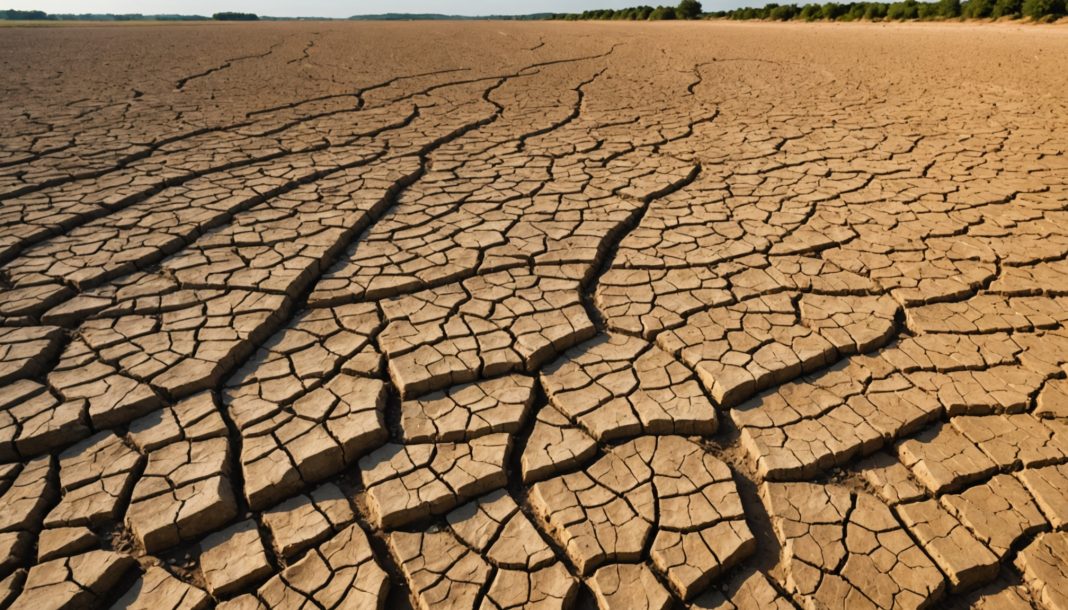
This summer of 2026, the map of drought in France is turning red across nearly the entire country. But behind the images of dry riverbeds and shut-off taps, another story is unfolding: that of a country quietly starting to change the way it manages water. Digital tools, redesigned soils, everyday habits: here is what's really at stake behind the restrictions.
A worrying state of affairs
In early August 2026, 65 departments were placed under crisis status, the highest alert level, and nearly 80% of mainland France was subject to at least one restriction measure. The cause: early spring heat waves, followed by a rainfall deficit that was never truly made up. As a result, groundwater levels are suffering in particular: according to readings from the BRGM (France's geological survey), 63% of monitoring points were below seasonal norms as of August 1, and 94% of tracked levels were falling. Smaller waterways haven't been spared either: the French Office for Biodiversity (OFB) reports that 43% of them are affected by interrupted flow or complete drying up, the worst situation since 2012. Alsace, Aquitaine, Auvergne, Limousin, and Midi-Pyrénées are among the hardest-hit regions, as are the departments of Creuse, Vendée, Loire-Atlantique, Aveyron, and Côte-d'Or.
VigiEau, the drought dashboard
Faced with this situation, water management has gone digital. The VigiEau tool, which replaced the former Propluvia service, lets every resident check in real time the restriction level applied in their town, simply by entering their address. Four tiers structure the system: vigilance, alert, heightened alert, and crisis, with this last level imposing a near-total ban on non-priority water uses, whether watering a garden, filling a pool, or washing a car. For local authorities, this tool is a game changer: it allows measures to be adjusted to the actual conditions of each watershed, rather than applying uniform rules across an entire department.
Giving soil back its sponge-like role
Beyond restrictions, an idea is gaining ground among hydrologists and planners: the sponge soil. The principle is to restore soil's natural ability to absorb and then release water, rather than letting it run off into sewers. This involves de-paving urban spaces, adding greenery to schoolyards and parking lots, and restoring wetlands capable of acting as natural reservoirs. The goal set out by water management stakeholders is clear: move from a reactive approach, in which drought is observed and then followed by restrictions, to an anticipatory one, in which land is designed to retain water well before summer arrives.
Solutions being deployed on the ground
- Collecting and storing rainwater in public buildings and private homes
- Reusing treated wastewater to water green spaces or for certain agricultural uses
- Gradually de-paving schoolyards, squares, and parking lots
- Restoring wetlands and small rivers to slow down water flow
- Issuing geolocated alerts via VigiEau to adjust behavior in real time
These initiatives alone won't be enough to offset such a severe rainfall deficit. But they outline a different path than simply acknowledging failure: check out our practical tips for saving water at home at /trucs-astuces/, or our advice for a water-efficient garden in /maison-et-jardin/. The issue goes well beyond ecology: it also touches on how regions are organized, a topic we follow closely in our /actualites-nationales/ section.
Frequently asked questions
How many departments are currently under crisis-level drought status?
In early August 2026, 65 French departments were classified at crisis level, the highest tier of the restriction scale, and about 80% of mainland France had at least one water restriction measure in place.
What is VigiEau and what is it used for?
VigiEau is the service that replaced Propluvia. It lets anyone enter their address to find out, in real time, the exact water restriction level that applies in their town, and therefore which uses are allowed or banned.
What does the term “sponge soil” mean?
It refers to a land-planning approach aimed at restoring soil's natural ability to absorb rainwater, through de-paving, adding greenery, or restoring wetlands, rather than letting it drain directly into sewer systems.
Sources
Widemedia – Water restrictions in France: the 2026 drought puts 65 departments into crisis
Agro Matin – Water resources: groundwater and small waterways are deteriorating sharply
This article was written with the help of artificial intelligence. Editorial policy

