


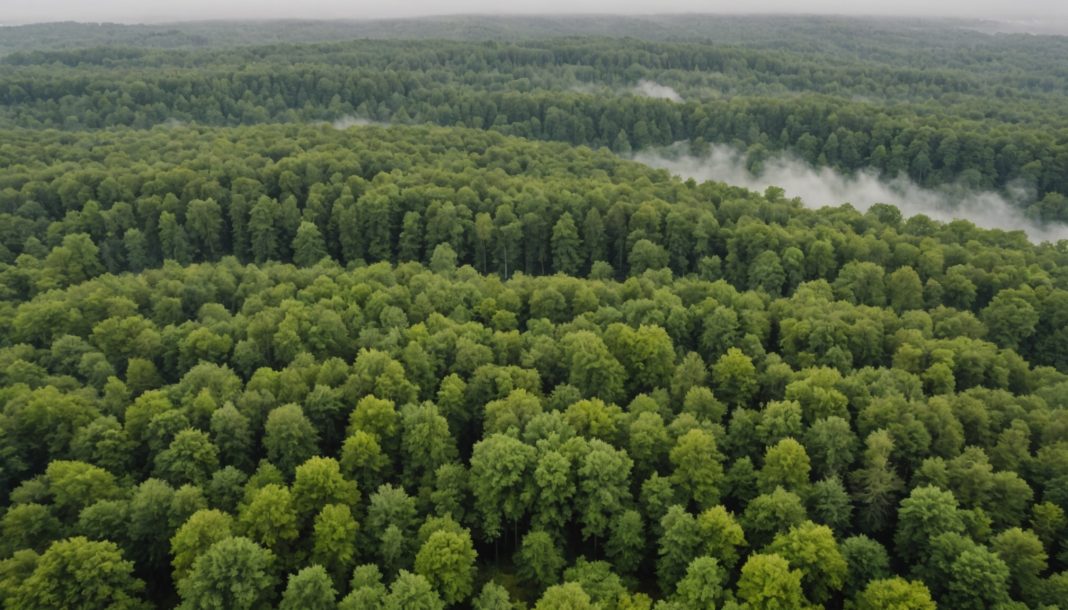
French forests have long been presented as a valuable ally in the fight against global warming, thanks to their ability to absorb atmospheric CO₂. But the latest results from the IGN's national forest inventory paint a more nuanced picture: the carbon sink of France's forests is clearly running out of steam, under the combined effect of repeated droughts and a growing number of health crises.
A Marked Slowdown in CO₂ Absorption
According to data published by the French National Institute of Geographic and Forest Information (IGN), mainland forests sequestered an average of 39 million metric tons of CO₂ per year over the 2015-2023 period, compared to 63 million metric tons per year over 2005-2013. This drop of nearly 40% shows just how much the destabilizing climate is already weighing on the country's natural capacity to offset part of its emissions.
Some regions have even moved into negative territory: forests in northeastern France now show a negative carbon balance, with their carbon stocks declining faster than they can rebuild.
Increasingly Weakened Trees
The national inventory paints a worrying picture of the health of forest stands. Nearly 8% of trees now show degraded condition or visible dieback, a proportion that has been rising steadily since this type of monitoring began. The Grand-Est region and mountain forests have the highest rates of damaged trees.
- Tree mortality up 125% over ten years
- Pathogen attacks up 175% since 2015
- Ash, chestnut, pedunculate oak, and Norway spruce among the most weakened species
These figures reflect the cumulative effect of successive droughts, which weaken trees' natural defenses and make them more vulnerable to pest insects and pathogenic fungi.
A Forest That Is Expanding but Growing More Fragile
An apparent paradox: forest area continues to grow. It now covers 17.6 million hectares, nearly a third of mainland France and Corsica. Total carbon stock has reached 1,350 million metric tons, and each hectare of forest now contains an average of 82 metric tons, compared to 73 metric tons in 2009 — a 21% increase over fifteen years.
But this geographic expansion should not obscure the growing fragility of forest ecosystems. IGN experts point out that a forest cannot be an infinite carbon sink: beyond a certain threshold of climate stress, it risks becoming a source of emissions itself, as dead trees decompose or burn.
Why This Matters to Everyone in France
Forests play a central role in France's national low-carbon strategy, which is meant to help the country meet its climate commitments. A slowdown in their absorption capacity forces a rethink of the available room to offset emissions from other sectors, whether transportation, industry, or construction. It also serves as a reminder that forest management — diversifying species, adapting to droughts, health monitoring — is becoming a strategic issue in its own right, not just a matter of preserving wooded area.
Frequently Asked Questions
What is a forest carbon sink?
It is a forest's ability to absorb more CO₂ than it emits, thanks to tree growth and the storage of carbon in wood, soil, and vegetation.
Why is the carbon sink of France's forests declining?
Mainly because of repeated droughts and a growing number of health crises (insects, fungi), which weaken trees and increase their mortality.
Is France's forest area shrinking too?
No, it continues to grow slightly, now reaching 17.6 million hectares, but this expansion does not offset the loss of vitality in existing forest stands.
To learn more, check out our analyses in the Science and Technology section, or follow general news in National News. Fans of the great outdoors can also visit our Travel – Tourism section.
Sources
- IGN — French National Institute of Geographic and Forest Information
- Actu-Environnement
- CNPF — National Forest Property Center
This article was written with the help of artificial intelligence. Editorial policy

