


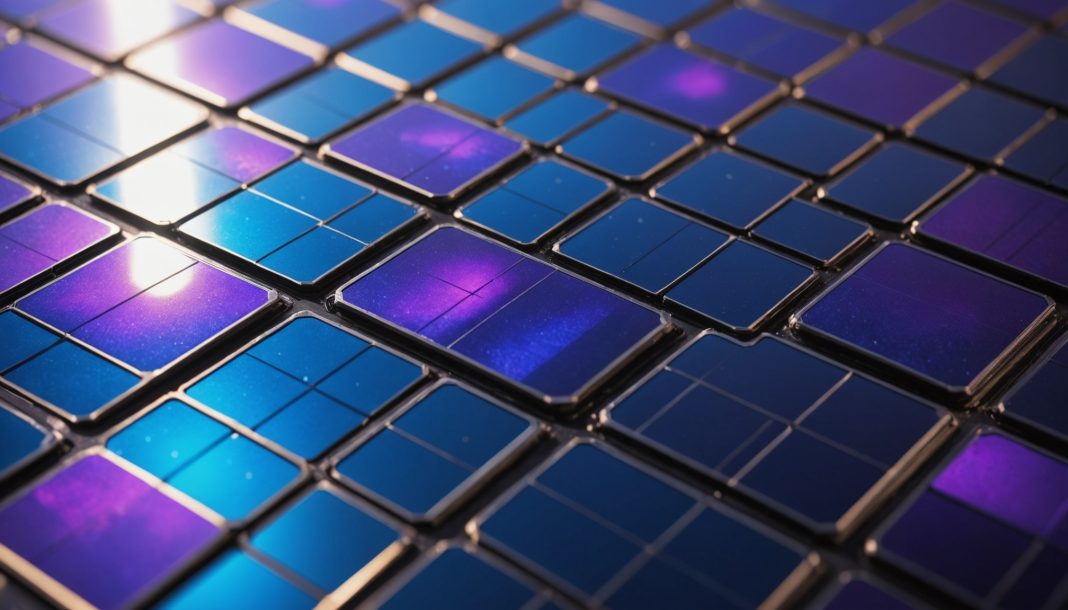
Chinese manufacturer LONGi has just announced a new world record for a tandem solar cell: an efficiency of 35.5%, validated by an independent European laboratory. Behind this figure, unveiled in Shanghai, lies a technological battle with very real consequences for the global energy transition. Here's a breakdown of a breakthrough that pushes the limits of the photovoltaic record.
A Certified Record of 35.5%
On July 14, 2026, at its annual conference on solar innovation held at Shanghai Jiao Tong University, LONGi unveiled a silicon-perovskite tandem cell with a conversion efficiency of 35.5%. The result was certified by the European Solar Test Installation (ESTI), part of the Joint Research Centre of the European Commission, in Italy. This third-party validation by a recognized body is essential: in the solar field, an uncertified figure carries little weight.
The technology relies on stacking two materials. The conventional silicon cell mainly captures red and infrared light, while a layer of perovskite added on top absorbs the blue part of the spectrum. By combining the two, far more energy is harvested than with silicon alone, whose theoretical limit in a single junction caps out around 29%.
Rapid Progress and Room to Grow
This record is not an isolated feat but the result of steady progress. The numbers speak for themselves:
- 33.9% in November 2023
- 34.6% in June 2024
- 35.5% in July 2026
Experts believe this tandem architecture could theoretically climb to around 43%. In other words, there's still considerable room for improvement. To put things in perspective, panels sold today average around 25% efficiency. Every percentage point gained means more electricity produced on the same surface area, a decisive advantage for both rooftops and large ground-mounted solar farms.
Lab vs. Mass Production: A Misconception to Set Aside
It would be misleading, however, to imagine this 35.5% figure showing up on our roofs tomorrow. This is a laboratory record, achieved on a small device under controlled conditions. LONGi has not disclosed the exact active surface area of the cell. The real challenge isn't breaking a one-off record, but manufacturing these cells at scale, reliably and cost-effectively.
Perovskite, in particular, is known to be fragile when exposed to humidity and heat. Its lifespan under real-world conditions remains the main industrial hurdle. Moving from a certified prototype to a module sold by the millions can take several years. That's where the true maturity of an industry is measured, far more than in the announcement of a spectacular figure.
Why This Record Matters Globally
Beyond the technical achievement, this announcement reflects the intensity of the international race in solar energy. Records keep falling among Chinese, European, and American players, each seeking to secure a technological edge in a strategic energy market. The fact that a Chinese manufacturer had its performance validated by a European laboratory also highlights just how globalized this research has become.
For the ecological transition, the stakes are clear: more efficient cells make it possible to produce the same amount of energy with less material and less space, improving the environmental and economic footprint of photovoltaics. This momentum matters just as much to players in technological research as to investors in the sector, who are watching closely for any breakthrough capable of reshuffling the energy industry.
Frequently Asked Questions
What is a tandem solar cell?
It's a cell that stacks two photovoltaic materials, in this case silicon and perovskite, to capture a wider share of the light spectrum. This allows it to exceed the maximum theoretical efficiency of a silicon-only cell.
Are these 35.5%-efficient panels already for sale?
No. This is a record achieved in a laboratory on a small device. Commercial modules today reach around 25%. Moving to reliable, affordable mass production will still take several years.
Why does certification by ESTI matter?
Because a claimed efficiency figure only has scientific value if it's measured by an independent body. ESTI, affiliated with the European Commission, ensures the figure has been verified according to recognized protocols.
Sources
- Generation-NT — 35.5% efficiency: a giant leap for solar power
- LONGi — Crystalline Silicon-Perovskite Tandem Solar Cell New World Efficiency
- Tecsol Quotidien — LONGi sets a 35.5% world record
This article was written with the help of artificial intelligence. Editorial policy

