


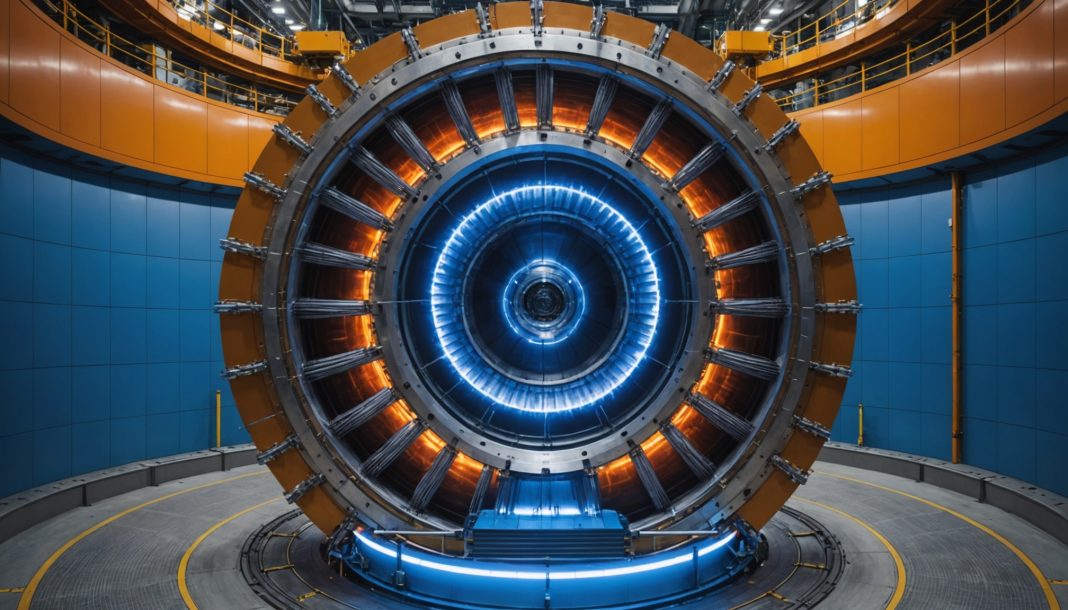
A technical milestone has just been reached at the site of the ITER international experimental reactor, in Cadarache, Provence. Assembly teams have completed installation of the sixth and final module of the central solenoid, forming the largest pulsed superconducting magnet ever built. A key component for the future of nuclear fusion, touted as a potentially almost limitless, low-carbon energy source.
An Extraordinary Piece of Engineering
ITER's central solenoid stands about 18 meters tall and weighs a total of roughly 1,000 tons. It is made up of six stacked modules, built from niobium-tin cables, a superconducting material capable of carrying an intense electric current with zero resistance, provided it is cooled to an extreme temperature: about -269°C, or 4 kelvins, the temperature of liquid helium.
Once operational, this magnet will need to generate a magnetic field reaching 13 teslas, nearly 280,000 times the Earth's magnetic field. Its role: to trigger and sustain the electric current that runs through the plasma, the gas superheated to more than 150 million degrees in which fusion reactions are meant to occur.
Why Nuclear Fusion Fascinates So Much
Unlike the fission used in today's nuclear power plants, fusion involves joining light atomic nuclei together rather than splitting them, a process similar to the one that powers the Sun. Its proponents see it as a path toward decarbonized energy produced without long-lived radioactive waste and without any risk of a runaway reaction. The ITER project, which brings together 35 countries including the European Union, the United States, China, Russia, Japan, India, and South Korea, aims to demonstrate the scientific and technical feasibility of this technology at large scale, before commercial reactors can be considered in the following decades.
In France, this effort comes alongside a dedicated research investment: the SupraFusion program, led by the CEA (the French atomic energy commission) and the CNRS (the French national center for scientific research) as part of the France 2030 plan, is meant to strengthen national expertise in superconductors and magnetic fusion physics.
What This Milestone Actually Changes
- It marks the completion of assembly of one of the most critical components of the future reactor, after several years of manufacturing and testing.
- It confirms the ability of the industry and laboratories involved to produce superconducting magnets on a scale never achieved before.
- It brings closer the timeline for “first plasma,” the stage at which teams will seek to achieve a controlled fusion reaction inside the machine.
- It fuels an entire industrial and economic sector built around superconducting materials, whose applications extend far beyond fusion alone, reaching as far as medical imaging and transportation.
Major milestones still remain before any real energy production: teams still need to integrate and test all of the tokamak's systems, the ring-shaped chamber where the plasma will circulate, before gradually ramping up power over several years.
Frequently Asked Questions
What is a superconducting magnet?
It is a magnet made from materials that, once cooled to extremely low temperatures, lose all electrical resistance. This allows them to carry very intense currents and generate powerful magnetic fields without losing energy as heat.
Why isn't nuclear fusion already used to produce electricity?
Maintaining a stable plasma at more than 150 million degrees while producing more energy than it takes to heat it remains a major scientific and technical challenge. ITER's very purpose is to demonstrate that this balance is achievable before commercial power plants can be considered.
When will ITER produce its first results?
The project's timeline calls for a gradual ramp-up in power after the machine's assembly is completed, with the first plasma experiments in the coming years, followed by full-power operations later on.
Sources
This article was written with the help of artificial intelligence. Editorial policy

