


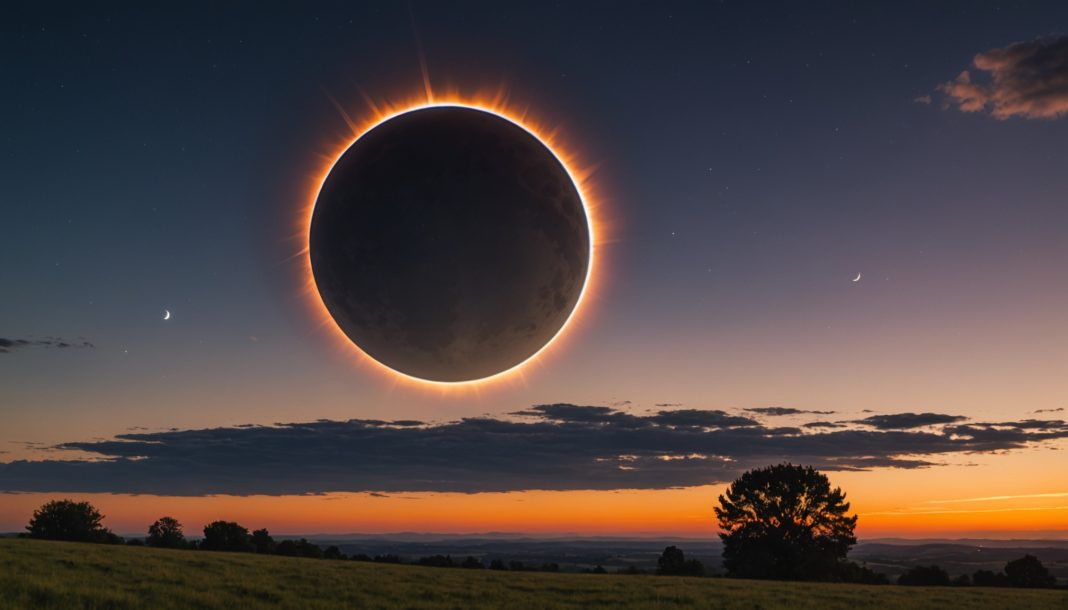
The countdown has begun. On August 12, 2026, an exceptionally rare solar eclipse of August 12, 2026 will sweep across the northern hemisphere, drawing thousands of curious observers from around the world. For the first time in more than a century, the path of totality will cross continental Europe, treating Spain to an unprecedented spectacle while France experiences a dramatic partial eclipse. Here's a look at a celestial event whose reach extends far beyond any single border.
A Path That Links Three Territories
The Moon's shadow will first touch Greenland, then continue over Iceland, near Reykjavik, before sweeping down over northern and eastern Spain, all the way to the Balearic Islands. This path makes the event the first total eclipse visible from mainland Spain in more than a century.
- Duration of totality: brief, between roughly 1 minute 40 seconds and 1 minute 54 seconds depending on the viewing location in Spain, and nearly a minute in Iceland.
- Timing: the eclipse occurs in the evening, around 8:30 p.m. local time in Spain, with the Sun very low on the horizon.
- Conditions: the Castilian Meseta (Burgos, León) offers the best odds of clear skies, while Iceland remains notoriously cloudy even in August.
France Gets a Front-Row Seat, But Only a Partial View
The path of totality does not cross mainland France, but the entire country will experience a very deep partial eclipse. With the Sun already low on the horizon, it will be obscured to impressive degrees depending on the city.
- Biarritz and the Basque coast: up to 99.5 percent of the disk covered.
- Toulouse: 97.8 percent — Bordeaux: 97.6 percent.
- Marseille: 96.3 percent — Paris: about 92 percent.
In Paris, the phenomenon begins around 7:22 p.m., peaks at 8:17 p.m., and ends at 9:09 p.m. A clear view of the western horizon will be essential to catch every moment of this eclipsed sunset. Astronomy enthusiasts can find everything they need to prepare their observation in the Science and Technology section.
Watching Safely: The Golden Rule
Looking directly at the Sun with the naked eye, even when partially covered, can cause irreversible eye damage. Experts stress a few essential precautions.
- Wear certified eclipse glasses meeting the ISO 12312-2 standard (CE marking), never ordinary sunglasses.
- Fit binoculars, cameras, and telescopes with a proper solar filter placed in front of the instrument's lens.
- For children, opt for pinhole projection using a piece of cardboard with a small hole punched in it.
An International Event Already Taking Shape
Hotels fully booked along Spain's Cantabrian coast, “eclipse chasers” converging on Iceland, travel agencies offering dedicated trips: the eclipse is fueling a genuine wave of cross-border astro-tourism. For France, there's also a historical dimension. The last total eclipse visible on French soil dates back to August 11, 1999, and the country will have to wait until September 3, 2081 to witness totality again. Those in more of a hurry can look ahead to August 2, 2027, when a new path of totality will sweep across southern Spain and North Africa. Plenty of inspiration for the kind of trips featured in the Travel and Tourism section, and for the stories followed in International News.
Frequently Asked Questions
Will the eclipse of August 12, 2026, be total in France?
No. Totality is limited to Greenland, Iceland, and Spain. In mainland France, the eclipse will be partial, with the Sun's disk covered anywhere from 90 percent to more than 99 percent depending on the region.
What time should you watch the eclipse?
The event takes place in the evening. In Paris, it begins around 7:22 p.m. and reaches its maximum around 8:17 p.m. In Spain, totality occurs around 8:30 p.m. local time.
What equipment do you need to watch the eclipse safely?
Eclipse glasses certified to the ISO 12312-2 standard are essential. For binoculars or telescopes, a front-mounted solar filter is mandatory. Ordinary sunglasses offer no protection for your eyes whatsoever.
Sources
- Stelvision — The Solar Eclipse of August 12, 2026
- Paris Observatory — Solar Eclipses
- Wikipedia — Solar Eclipse of August 12, 2026
This article was written with the help of artificial intelligence. Editorial policy

