


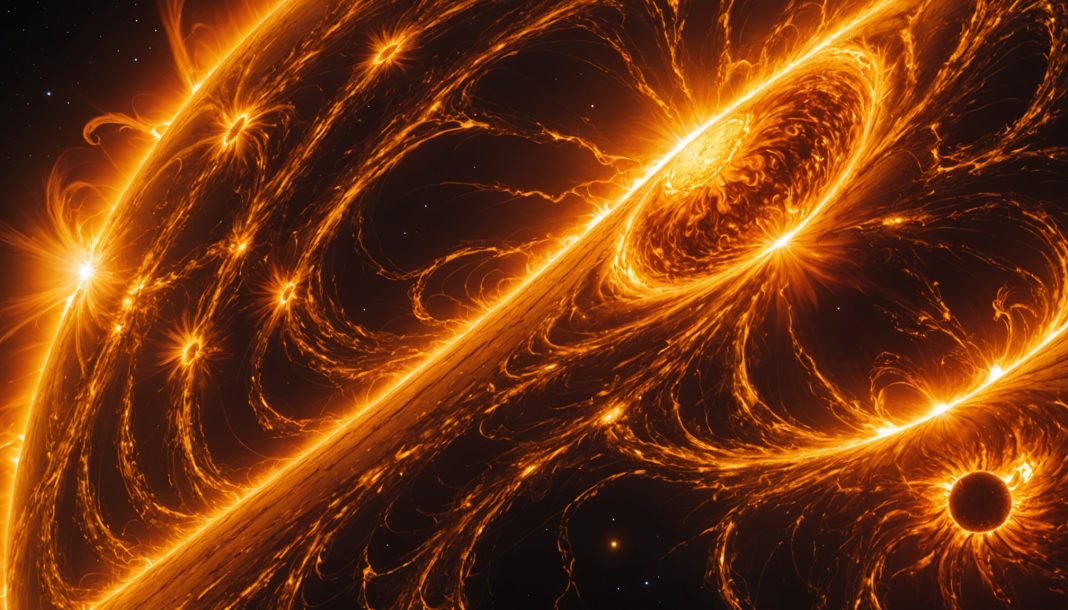
On August 5, 2026, an international team of astronomers unveiled in the journal Nature the most detailed images ever obtained of the Sun's surface. They reveal thousands of mini plasma vortices, barely twenty kilometers wide, never before observed on our star. This discovery could shed light on a decades-old mystery: why is the Sun's atmosphere hundreds of times hotter than its surface?
The Most Powerful Telescope Ever Aimed at the Sun
The images were obtained using the Daniel K. Inouye Solar Telescope, located near the summit of the Haleakalā volcano on the island of Maui, Hawaii, and operated by the U.S. National Science Foundation. With its four-meter mirror, it is the most powerful solar telescope in the world. To spot the structures they were looking for, the team had to distinguish details barely twenty kilometers across on the surface of a star located about 150 million kilometers from Earth — an unprecedented level of resolution for this type of observation.
By combining these observations with computer simulations, the researchers identified the signature of a well-known phenomenon in fluid dynamics, the Kelvin-Helmholtz instability. It occurs when two layers of matter move at different speeds and slide against each other, somewhat like the wind rippling the crest of waves on the ocean's surface. On the Sun, this shearing gives rise to a cascade of plasma vortices spaced about fifty to sixty kilometers apart.
A Promising Lead for Unraveling the Mystery of the Sun's Heat
The Kelvin-Helmholtz phenomenon had already been observed on Earth, in the atmospheres of other planets, and even in the solar corona, the thin atmosphere surrounding the Sun. However, this is the first time it has been directly confirmed on the star's visible surface, in the layer called the photosphere.
- Plasma vortices about 20 kilometers in diameter, never visualized before
- A lead for explaining how magnetic energy propagates much faster than current models predict
- A possible link to nanoflares, those tiny bursts of energy that could heat the Sun's upper atmosphere
According to the researchers, these vortices could help twist magnetic field lines and store up the energy released during small eruptions called nanoflares. This mechanism is one of the leading theories proposed to explain why the solar corona reaches temperatures of several million degrees, while the Sun's surface just below it does not exceed about 5,500 degrees — a puzzle that has occupied solar physicists since the 1940s.
Why This Discovery Matters Beyond the Scientific World
Better understanding the dynamics of the solar atmosphere isn't just an academic question. Eruptions and magnetic storms that originate on the Sun's surface can disrupt satellite communications, power grids, and geolocation systems on Earth. Refining the physical models of these phenomena, as these new observations make possible, will ultimately help better anticipate space weather and its effects on everyday technology.
The research team now plans to carry out more observation campaigns with the Inouye telescope to determine whether these vortices are a permanent feature of the Sun's surface or whether they appear only under certain solar activity conditions.
This advance is part of the latest news in our international news section, alongside our science and technology and high-tech and digital content.
Frequently Asked Questions
What is the Inouye Solar Telescope?
It is the most powerful solar telescope in the world, located in Hawaii and operated by the U.S. National Science Foundation. Its four-meter mirror allows it to observe the Sun's surface with an unprecedented level of detail.
What is the Kelvin-Helmholtz instability?
It is a fluid dynamics phenomenon that occurs when two layers of matter slide against each other at different speeds, creating vortices. It is well known on Earth and had already been detected in the Sun's atmosphere, but not directly on its surface.
How could this discovery explain the Sun's heat?
Researchers believe these vortices could help magnetic energy propagate faster than expected and fuel small eruptions, which would help explain why the solar atmosphere is far hotter than its surface.
Sources
National Solar Observatory (NSO) — official press release
CNN — Unprecedented views of sun's surface
ScienceAlert — Record-breaking images of the Sun
This article was written with the help of artificial intelligence. Editorial policy

