


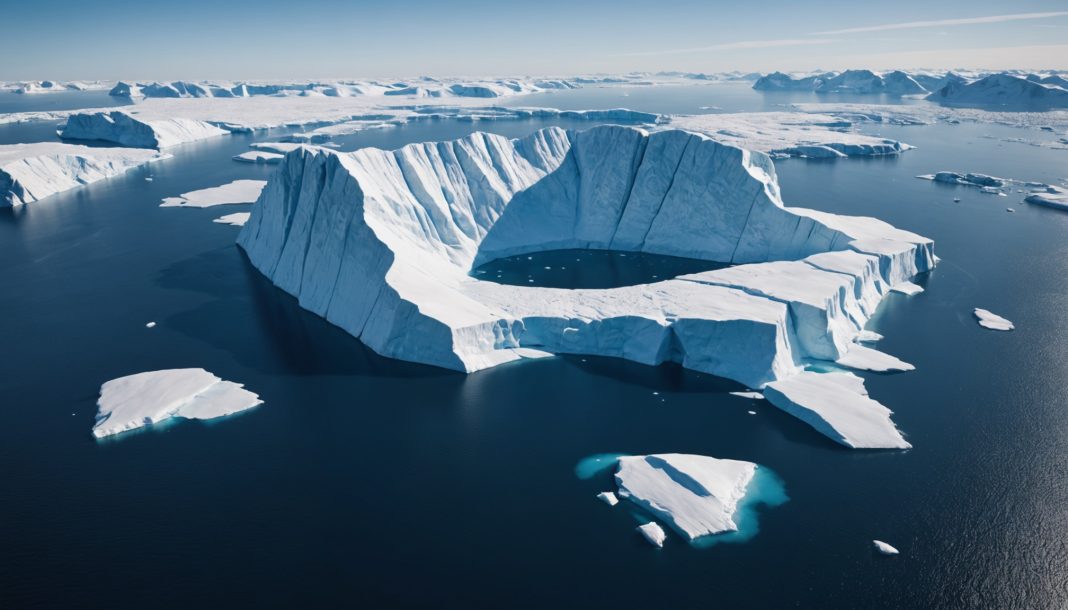
On August 4, 2026, a block of ice measuring 76 square kilometers — an area comparable to the island of Manhattan — broke off the floating tongue of the Petermann Glacier, in northwest Greenland. This is the largest calving event observed in the Arctic since 2020, and the biggest chunk lost by this glacier since 2012.
A Fracture Monitored for Months
The break did not surprise scientists who have been tracking Petermann since 2019. As early as April 2026, an imaging technique called interferometry had revealed deformations and cracks in the glacier's floating tongue, four months before the actual break. It was ultimately Adam Garbo, a glaciology PhD student at the University of Ottawa, who spotted the break on August 4 using images from the European Sentinel-1 satellite.
Monitoring this glacier involves an international team — the universities of Ottawa, Stirling, Lancaster, and Leeds, along with the Canadian Ice Service — in a project partly funded by the European Space Agency (ESA).
An Iceberg That Hit an Island Without Breaking Apart
After separating, the block of ice drifted through Nares Strait and struck Joe Island. Unlike a previous iceberg that was fractured by the same rocky obstacle in 2010, this one remained intact despite the impact. Satellites continue to track its path as it moves further south.
Why This Probably Isn't Over
Glaciologists are now monitoring two other sections of the floating tongue, where existing cracks suggest an upcoming break. These are estimated at about 94 and 84 square kilometers respectively. If both of these blocks were to break off as well, a total of nearly 254 square kilometers of floating ice would disappear — about 22% of the glacier tongue's current surface area.
- August 4, 2026: a 76-square-kilometer block breaks off, the largest since 2012
- Estimated thickness of the block: up to 150 meters
- Two more blocks (94 km² and 84 km²) under watch
- Potential cumulative loss: about 22% of the floating tongue
One More Symptom of Arctic Warming
This event is part of a broader acceleration of changes observed at the poles. It echoes the hottest summer ever recorded in France, which this year broke the 2003 record, as well as the worrying decline of birds and bats observed by French naturalists — two indicators pointing in the same direction. The effects of climate change extend far beyond the Arctic's borders: we recently discussed how resilient seeds are being developed in Africa to cope with more frequent droughts.
Frequently Asked Questions
Why is the Petermann Glacier monitored so closely?
Petermann is one of Greenland's largest outlet glaciers. Its floating tongue acts as a brake that slows the flow of continental ice toward the ocean; its fragmentation worries scientists, who fear it could accelerate melting further upstream.
Does this iceberg pose a direct danger?
No, no inhabited area is directly threatened. The iceberg is drifting in Nares Strait, an isolated area between Greenland and Ellesmere Island, Canada. Scientists are mainly tracking it as a climate indicator.
When might the other two blocks break off?
No precise date has been given. Glaciologists suggest it could happen soon, given the state of the cracks already observed, but they cannot say for certain.
Sources
- ESA — Petermann Glacier calves huge iceberg
- Futura-Sciences — An ice island the size of Manhattan has broken off
- Imep-CNRS — Greenland: Petermann Glacier loses 76 km² of floating tongue
This article was written with the help of artificial intelligence. Editorial policy

