


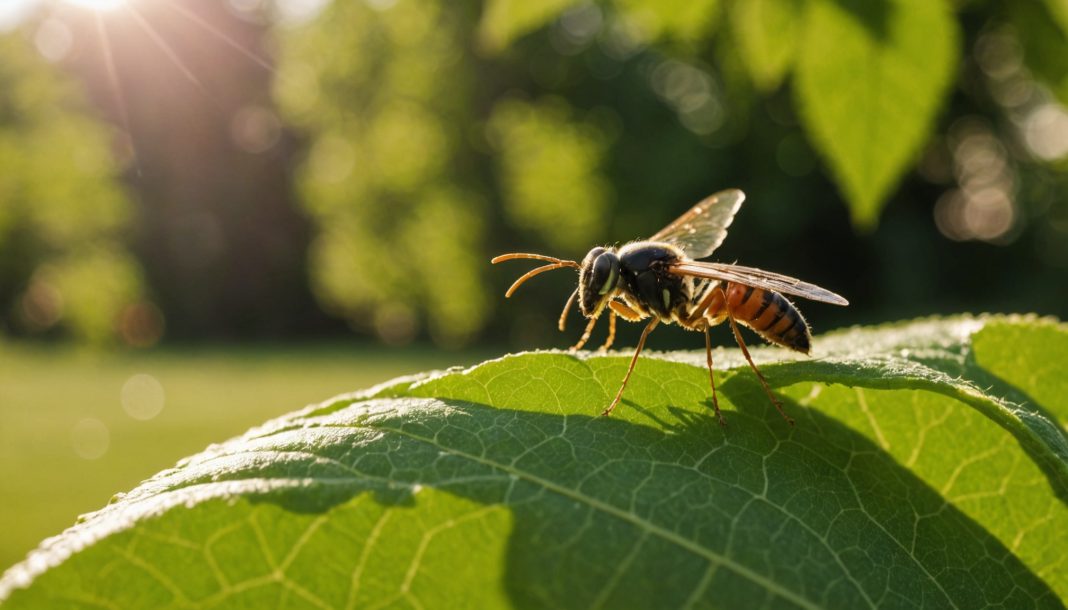
They measure just a few millimeters, go unnoticed in a garden or a wheat field, and yet they provide agriculture with a considerable service: parasitoid wasps naturally regulate populations of harmful insects. A study conducted by the Centre de Recherche sur la Biodiversité et l'Environnement (CRBE, a joint research center run by the CNRS—France's National Center for Scientific Research—together with the IRD and the University of Toulouse) shows that the growing frequency of heat waves is seriously weakening these valuable allies of crops.
Discreet Allies of Farmers
Unlike the wasps people shoo away from a patio in summer, parasitoid wasps don't sting humans. Their reproductive strategy, however, is formidable for pests: the female lays her eggs inside or on the surface of another insect, which serves as a host. The larvae develop by gradually consuming the host, eventually killing it. This cycle makes them natural regulators of pest populations, long used by farmers as an alternative or complement to chemical treatments, particularly in biological pest control in greenhouses and open fields.
What the CNRS Study Reveals
Published in the journal Ecology Letters, the CRBE's research experimentally tested the interactions between four species of tropical parasitoids and seven species of host fruit flies, under two thermal scenarios: a 4°C warming, raising the temperature to 28°C, and an equivalent cooling, bringing it down to 20°C.
- At 28°C, the success rate of parasitoid development drops sharply.
- The weakened insects are only able to exploit a reduced number of host species, even though they are naturally capable of attacking several different pests.
- Conversely, cooling to 20°C has only a moderate effect on their performance.
In other words, it is not milder winters that threaten these beneficial insects, but rather heat spikes, which are becoming increasingly frequent and intense as the climate warms.
A Disrupted Biological Calendar
Beyond the direct effect of heat on their development, climate change is also disrupting the biological calendar of many insects. Several species now emerge earlier in spring and summer. This shift can desynchronize the presence of beneficial insects from that of their prey: when pests proliferate on crops, their natural predators are no longer systematically there, which reduces their effectiveness precisely when it would be most useful.
What Consequences for Agriculture?
This dual effect—weakened development and seasonal desynchronization—has researchers worried about a rise in pest insect populations in the years ahead, with an increased risk of crop losses. For farms that rely on biological pest control rather than pesticides, this weakening of natural allies is a warning sign: it could push some producers back toward chemical treatments, running counter to goals of reducing pesticide use. The researchers are calling for these delicate ecological balances to be better factored into climate change adaptation strategies, whether for large-scale crops or home gardens, where the same insects provide similar services. This topic is part of the broader issues covered in our Ecology & Climate section.
Gardening enthusiasts, who are also affected by the balance of their vegetable patch, can find our tips in the Home & Garden section, while research developments on these topics can be followed in our Science & Technology section.
Frequently Asked Questions
What Is a Parasitoid Wasp?
It is an insect, usually very small, that lays its eggs in or on another host insect. The larvae feed on this host as they develop, eventually killing it and thereby regulating pest populations.
Why Does Heat Weaken These Insects?
According to the CRBE study, a 4°C rise strongly disrupts their development and reduces the number of host species they manage to exploit, whereas an equivalent drop in temperature has only a limited impact on their performance.
What Solutions Exist for Farmers?
Researchers recommend factoring these climate vulnerabilities into biological pest control strategies, for example by diversifying the beneficial insects used and adjusting the timing of their introduction to match new seasonal calendars.
Sources
- CNRS INEE
- notre-environnement.gouv.fr (French Ministry of Ecological Transition)
- Agroscope (Switzerland)
This article was written with the help of artificial intelligence. Editorial policy

