


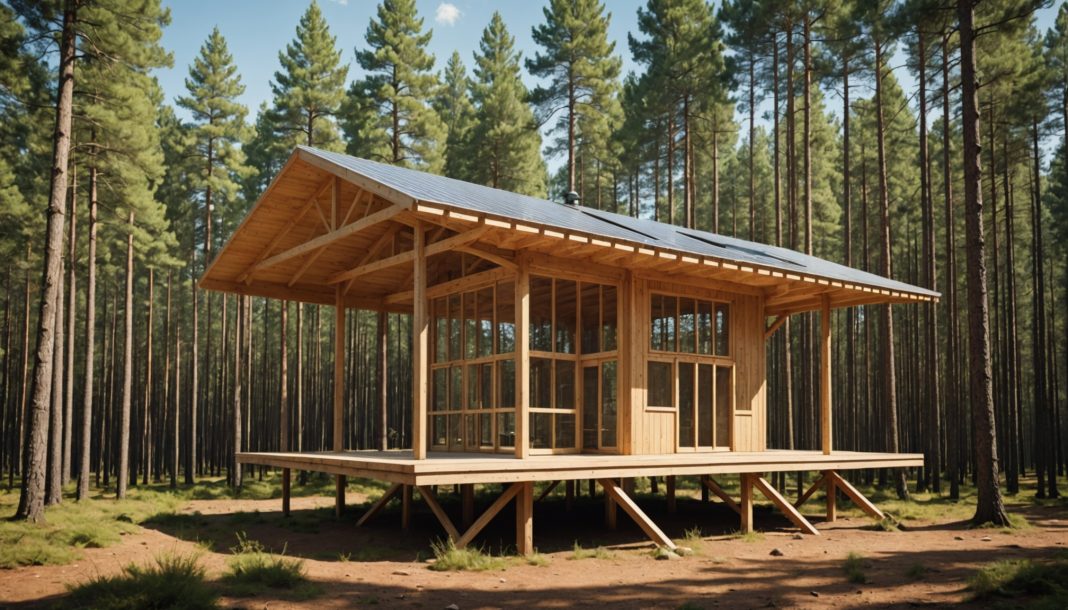
Under a nine-meter-high wooden shelter nestled in the Floirac forest, in Gironde, an unprecedented forest drought experiment is underway on a full scale, several years in the making: a movable roof deliberately deprives maritime pines of part of the rainfall to simulate, starting today, the climate the region could experience by the end of the century. Led by the French National Forestry Office (ONF), the University of Bordeaux, and INRAE (the French National Research Institute for Agriculture, Food and the Environment), this study takes on particular significance after a summer of 2026 marked by several heat waves and a drought affecting nearly all of France's departments.
An Extraordinary Setup Installed on the Outskirts of Bordeaux
The experimental site is located on the grounds of the former Bordeaux astronomical observatory, a few kilometers from downtown Bordeaux. About 336 maritime pines, sourced from various origins (Spain, Portugal, Atlantic coastal dunes) and including genetically improved varieties, were planted there and then placed under a structure capable of reducing rainfall by 30 to 60% thanks to a movable roof installed above the canopy. The goal: to artificially reproduce, without waiting several decades, the water conditions expected in southwestern France by the end of the 21st century.
- Structure: a 9-meter-high wooden shelter with a movable roof
- Species studied: the maritime pine, an economic pillar of the Landes forest
- Simulated rainfall reduction: 30 to 60%, depending on the plot
- Planned duration of scientific monitoring: about ten years
Researchers continuously measure soil water content and evaporation, as well as the trees' hydraulic function and transpiration. This data should help determine how well maritime pines, already strained by successive droughts in recent years, will be able to withstand a climate that is durably hotter and drier.
Anticipating the Management of Production Forests
The Landes de Gascogne forest, the largest cultivated forest in Western Europe, relies almost entirely on the maritime pine. A lasting weakening of this species would have direct consequences for an entire regional economic sector, from sawmilling to paper pulp. That is why the project brings together, alongside scientists, institutional and professional partners such as the Nouvelle-Aquitaine Region and the France Bois Forêt trade association, directly concerned with the economic viability of the timber resource in the decades ahead.
An extension of the setup is already planned: about 400 oak trees are to be planted at the same site in order to compare the resistance of forest species to water scarcity, pitting temperate species against more Mediterranean varieties that may be better equipped for the region's future climate.
Lessons That Go Beyond the Landes Forest Alone
Beyond professional forestry, the expected results are meant to inform broader recommendations on adapting trees and green spaces to a drier climate, an issue that concerns public forests as much as private gardens or tree-lined city streets. This type of experimental platform is part of a wider push for applied research on climate change, at a time when several scientific institutes are multiplying field protocols to anticipate, rather than endure, the coming decades of warming.
The first partial, still preliminary results suggest that some genetically improved varieties of maritime pine hold up overall as well as the historic local populations under water stress—a signal the project's leaders consider encouraging, without yet dispelling all long-term concerns.
Frequently Asked Questions
Where is this forest drought experiment located?
The setup is installed in Floirac, in Gironde, on the grounds of the former Bordeaux astronomical observatory, in the middle of a plot planted with maritime pines.
How is the future climate simulated without waiting decades?
A movable roof installed above the canopy intercepts part of the rainfall, artificially reducing the precipitation received by the trees by 30 to 60%, depending on the area of the setup.
Why is the maritime pine studied in particular?
It is the dominant species in the Landes de Gascogne forest, a major economic resource for the timber industry in southwestern France, which makes its resilience to drought strategically important for the entire region.
Sources
French National Forestry Office (ONF) —
INRAE —
Orange Actu
This article was written with the help of artificial intelligence. Editorial policy

, an unprecedented forest experiment deprives maritime pines of rainfall to simulate the climate of the end of the century now.)