


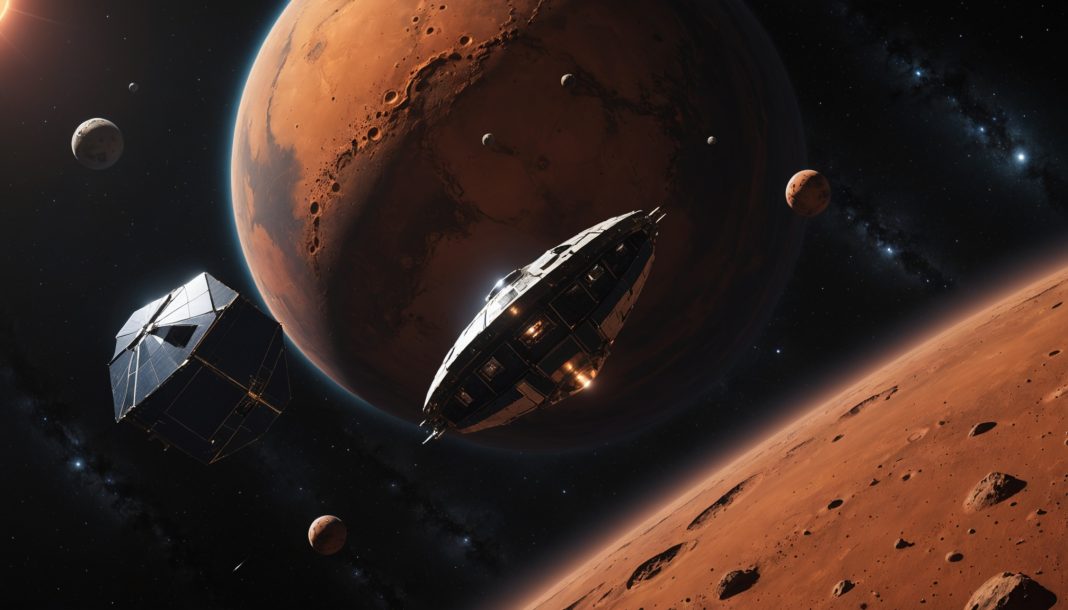
On May 15, 2026, NASA's Psyche probe skimmed past Mars at a distance of just 4,609 kilometers from its surface, as part of a gravity-assist maneuver designed to propel it toward one of the most intriguing objects in the solar system: the metal asteroid 16 Psyche. Data and a spectacular time-lapse of the encounter have just been released by the Jet Propulsion Laboratory (JPL), one of NASA's leading centers.
A Detour by Mars to Gain Speed
Launched on October 13, 2023, the Psyche probe is making a 3.5-billion-kilometer journey before reaching its target, expected in the summer of 2029. Rather than heading straight there, the mission took a calculated detour past Mars: by passing close to the red planet, the spacecraft used its gravitational field as a kind of cosmic slingshot, gaining speed and adjusting its trajectory without burning a single extra drop of fuel.
According to JPL's navigation teams, the trajectory was tracked with remarkable precision: the probe passed exactly where it needed to in order to stay on course for its 2029 rendezvous with the asteroid.
Scientific Instruments Put to the Test
This close pass was not merely an orbital formality: it allowed the team to calibrate and test the probe's three main instruments under real conditions, ahead of the actual study phase of the asteroid:
- The imager captured details of the Martian surface (craters, the south polar cap) as well as views of the moons Phobos and Deimos.
- The magnetometer detected signatures of the bow shock, the region where the solar wind collides with Mars's magnetic field.
- The neutron spectrometer successfully recorded neutrons emitted by the Martian surface and atmosphere.
This technical milestone confirms that all of the equipment is working properly ahead of arrival at the final target.
Why an Entirely Metallic Asteroid Fascinates Scientists
16 Psyche, located in the main belt between Mars and Jupiter, stands apart from most known asteroids, which tend to be rocky or icy. Scientists believe it could be the fossilized metallic core of an ancient planetesimal—a planetary embryo destroyed during the violent collisions that marked the early solar system. Studying it would amount, in a sense, to directly observing the core of a planet, something impossible to do on Earth.
The mission is set to resume continuous thrust using its solar-electric propulsion system in the fall of 2026, before continuing its long journey toward the asteroid. This development follows in the footsteps of the major space explorations regularly covered in our Science and Technology section.
A Mission Closely Followed by the Tech Community
Beyond specialist circles, the event was widely covered by the High Tech – Digital community, which has a keen appetite for fresh images from space. The time-lapse of the flyby, released by NASA, shows the red planet passing by in just under a month of condensed footage, a technical feat that illustrates the ongoing progress of onboard imaging.
Frequently Asked Questions
What is a gravity assist?
It is a technique that uses a planet's gravity to accelerate or alter the trajectory of a spacecraft, without using any extra fuel.
Why is the asteroid 16 Psyche of such interest to researchers?
Because it is believed to be made largely of metal (iron and nickel), an extremely rare composition that could correspond to the exposed core of an ancient proto-planet.
When is the probe expected to reach its target?
The rendezvous with the asteroid 16 Psyche is scheduled for the summer of 2029, nearly six years after the mission launched in October 2023.
Find more science and international news in our International News section.
Sources
- NASA JPL — NASA's Psyche Mission Delivers Mars Flyby Data, Time-lapse Video
- ScienceDaily — NASA's Psyche spacecraft aces Mars flyby
- KultureGeek — La sonde Psyche frôle Mars pour filer vers un mystérieux astéroïde métallique
This article was written with the help of artificial intelligence. Editorial policy

