


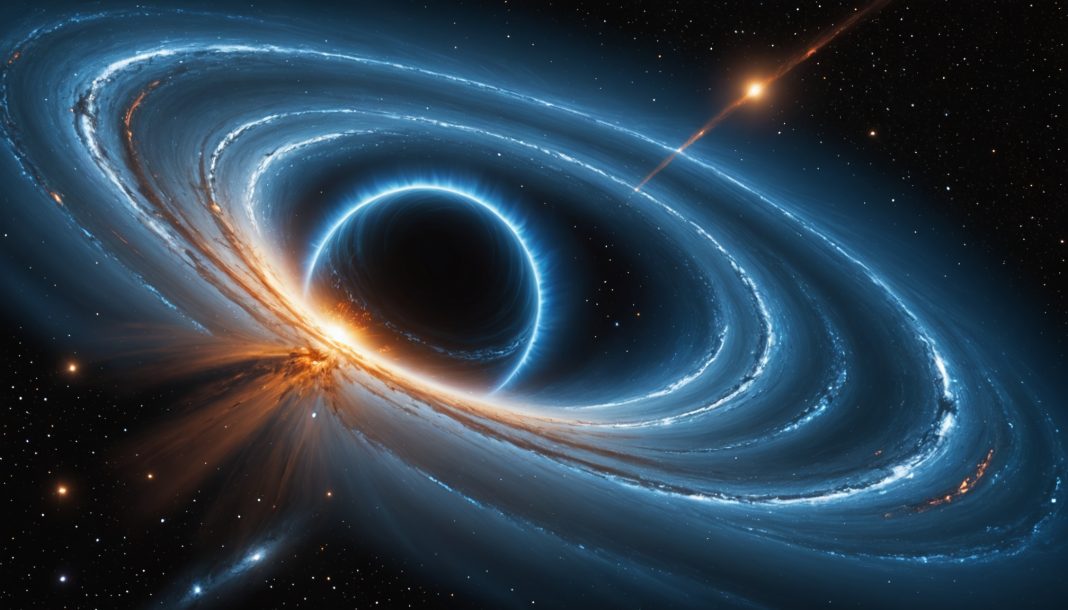
At the heart of the Milky Way, a star has just broken every speed record ever measured for an object in our galaxy. Named S301, it races around the central supermassive black hole at such a breathtaking pace that it is shaking up astrophysicists' certainties about the formation of stellar systems near this gravitational monster.
A Speed Beyond Comprehension
Using the GRAVITY instrument installed on the Very Large Telescope (VLT) at the European Southern Observatory in Chile, an international team of astronomers measured S301's trajectory over several years of painstaking observation. The result: at its closest approach to Sagittarius A*, the supermassive black hole at the center of our galaxy, the star reaches a peak speed of about 25,000 kilometers per second, or nearly 8.5 percent of the speed of light. No other star, in the Milky Way or anywhere else, had ever been measured moving that fast.
S301 completes its orbit around the black hole in only about 8.7 years, an extremely short period for a celestial object of this kind. The star itself is about 50 percent more massive than our Sun and five times more luminous, characteristics that make it a prime candidate for future precision observations.
A Remnant of a Disrupted Binary System
How can an ordinary star reach such an extreme speed? Researchers favor a hypothesis already proposed for other hypervelocity stars: S301 may once have belonged to a binary pair that strayed too close to the supermassive black hole. The colossal tidal forces exerted by Sagittarius A* would then have torn the pair apart, flinging one of the two stars into intergalactic space at tremendous speed, while the other—S301—remained captured, trapped in a tight orbit around the black hole.
This scenario, known to astrophysicists as the Hills mechanism, had never before been documented with an example of a star this fast and this close to a galactic black hole. The discovery, published in a leading scientific journal in mid-August 2026, opens an unprecedented window onto the extreme phenomena unfolding at the center of our galaxy.
Toward a Full-Scale Test of General Relativity
Beyond the observational feat, S301 is of the utmost interest to theoretical physicists. On such a tight, fast orbit around a supermassive black hole, the star experiences measurable relativistic effects: gravitational redshift of its light, precession of its orbit, and perhaps, within a decade of further observation, the possibility of directly determining the spin of the Sagittarius A* black hole, a value that remains largely a mystery.
This prospect excites the scientific community: if future observation campaigns confirm the predictions, S301 could become a genuine natural laboratory for testing Einstein's theory of general relativity under gravitational conditions never before explored. The stakes reach far beyond pure astronomy, touching on the very foundations of modern physics.
This news highlights just how much advances in high-tech instrumentation are transforming our understanding of the universe. For stargazing enthusiasts, this kind of discovery also fuels a growing passion for amateur astronomy, an accessible hobby covered in our leisure and hobbies section. Some public observatories even organize observation nights that are increasingly popular among fans of science-themed travel.
Frequently Asked Questions
What exactly is the star S301?
S301 is a recently detected star in a very tight orbit around Sagittarius A*, the supermassive black hole at the center of the Milky Way. It holds the record for the highest speed ever measured for a star in our galaxy, reaching about 25,000 km/s at its closest approach to the black hole.
How did astronomers measure such an extreme speed?
Researchers used the GRAVITY instrument on the Very Large Telescope at the European Southern Observatory in Chile, which allows extremely precise tracking of the movement of stars located in the immediate vicinity of the galactic center.
Why is this discovery important for physics?
Because S301's extremely tight orbit around a supermassive black hole could eventually allow scientists to directly measure relativistic effects and the black hole's spin, offering a full-scale test of the theory of general relativity.
Sources
- La Libre — Scientists discover the fastest star in our galaxy
- RTS — Milky Way: the fastest star races at 25,000 km/s
- Science (AAAS) — Fastest known star could reveal the spin of our galaxy's giant black hole
This article was written with the help of artificial intelligence. Editorial policy

