


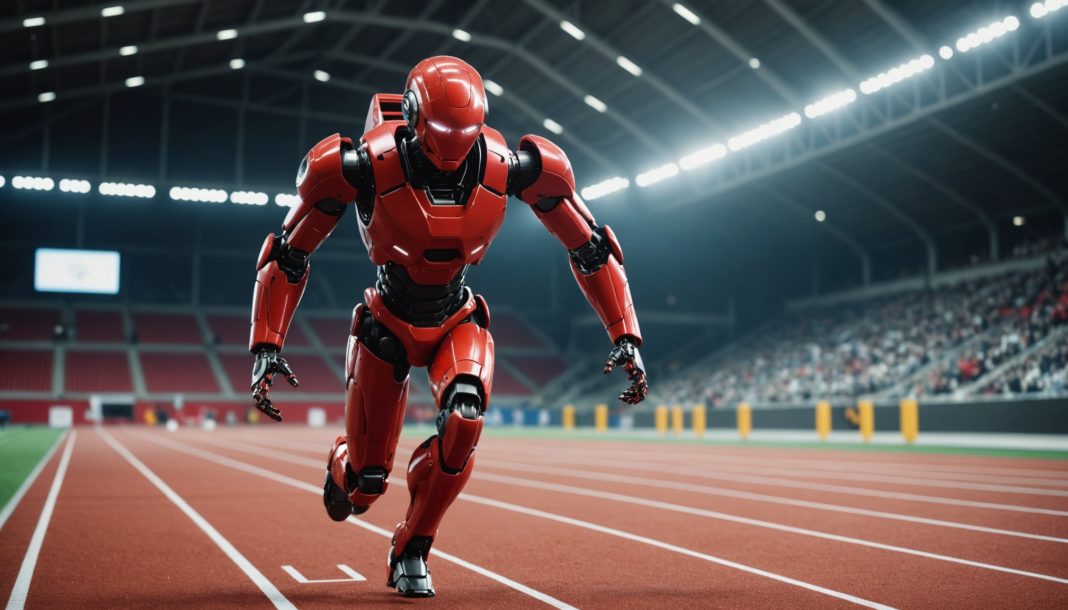
In Beijing, a humanoid robot managed to break, then shatter three times in just a few days, the world record for the 100 meters previously held by a flesh-and-blood athlete. The feat took place during the World Humanoid Robot Games 2026, an unprecedented sporting competition reserved entirely for human-shaped machines, which brought together more than two thousand robots from around the world.
A Human Record Erased in a Matter of Seconds
On August 22, 2026, at the National Speed Skating Oval built for the 2022 Beijing Winter Olympics and converted for the occasion into a track-and-field course, a humanoid developed by the Beijing Innovation Centre of Humanoid Robotics covered the distance in 9.39 seconds. This performance erased the benchmark time set by Usain Bolt in 2009, at 9.58 seconds. But the story didn't end there: three days later, another robot, named Tiangong Ultra and designed by a Beijing-based team, pushed the limit to 8.86 seconds, before a third time fell the very next day, at 8.64 seconds. In just one year, the speed of the best robotic sprinters thus more than doubled, with the winning time from the previous edition still hovering around 21.5 seconds.
This spectacular acceleration illustrates the progress made in barely a year on the motors, batteries, and motor-control algorithms that allow a bipedal machine to maintain its balance at very high speed, a technical challenge considerably more complex than that faced by a wheeled robot.
The World Humanoid Robot Games, a Showcase for Chinese Robotics
Held in Beijing, the World Humanoid Robot Games brought together teams from several countries for events modeled on the classic Olympic program: running, high jump, but also soccer and boxing between robots. The event drew crowds of curious onlookers, eager to see firsthand what humanoid robotics is now capable of producing outside the laboratory. It confirms China's position in a global technological race that also includes North American and European companies, each seeking to demonstrate the reliability of their machines under conditions close to real competition rather than in a controlled environment.
This buzz around robotics is part of a broader wave of technological transformation affecting numerous sectors this year, from industry to services, and accompanying the rapid evolution of digital tools observed in 2026.
A Spectacular Feat, But Not Without a Few Hiccups
Not every run on the track went off without a hitch. Several videos circulated during the event show robots losing their balance toward the end of a race, with one of them even ending its run by crashing into a safety wall right after setting a new record. These images, widely picked up by the international press, are a reminder that humanoid robotics remains a field still being fine-tuned, where raw performance still coexists with room for improvement in the safety and reliability of the machines.
Beyond the spectacle, these demonstrations also raise the question of how to regulate increasingly autonomous and fast-moving systems in the future, an issue closely followed by international organizations calling for a clear framework for automated systems. It adds to a series of advances in applied artificial intelligence that, in recent months, has also fueled debate over how fast artificial intelligence is progressing in a wide range of fields.
Toward New Robotic Competitions
The organizers of the World Humanoid Robot Games have already announced their intention to make the event a lasting one, with the ambition of turning it into a regular gathering where the world's top robotics teams would compete every year. For the engineers present in Beijing, the competition serves above all as a full-scale laboratory: every fall, every record, and every technical glitch feeds into the next generations of robots, in a field where science and technology are now advancing almost as fast as their own creations.
Frequently Asked Questions
What is the new 100-meter record set by a humanoid robot?
The best time recorded at the World Humanoid Robot Games 2026 in Beijing is 8.64 seconds, compared with 9.58 seconds for the human record held by Usain Bolt since 2009.
Where and when did this event take place?
The competition was held in Beijing in late August 2026, at the National Speed Skating Oval built for the 2022 Winter Olympics, converted for the occasion into a racetrack for robots.
What other events were part of the World Humanoid Robot Games?
In addition to the sprint, the event included several disciplines inspired by the classic Olympic program, including high jump, soccer, and boxing between humanoid robots.
Sources
This article was written with the help of artificial intelligence. Editorial policy

