


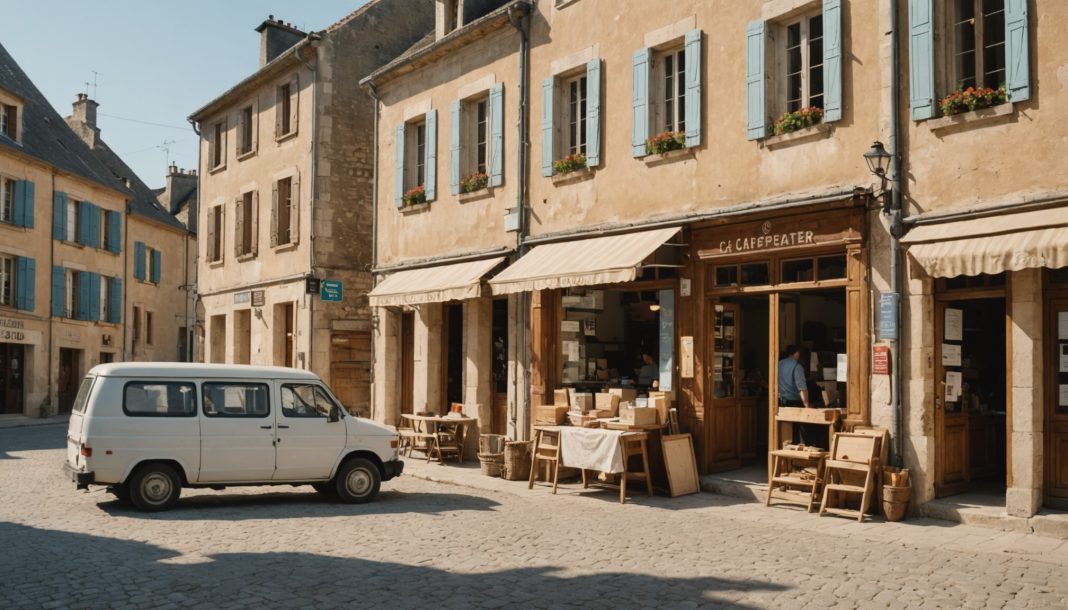
The report presented in late June 2026 by the French Senate's Delegation for Businesses hit like an electric shock: 62% of French towns no longer have a single shop, meaning more than 21,000 municipalities now lack a bakery, a grocery store, or a post office. That figure compares with the 25% of towns without shops recorded in 1980. Yet at the very same time, another indicator is climbing fast: the creation of craft businesses is booming in these same rural areas. How can we explain this paradox that is quietly redrawing the map of local services?
A Statistical Shock: 21,000 Towns Without a Single Shop
The figures reported by Public Sénat are unequivocal. Over the past four decades, France has lost half of its local points of sale. The opening of a new hypermarket leads, on average, to the disappearance of 20% to 30% of small food shops within a 20 to 30 kilometer radius, and this happens within the first four years alone. The phenomenon isn't limited to the countryside: the national average commercial vacancy rate now stands at 11.6%, climbing to 16.8% in suburban shopping centers.
To address this erosion, senators have proposed creating “priority retail zones”, modeled on urban free zones (zones franches urbaines): targeted tax breaks, a moratorium on new square footage for large suburban stores, and mobilizing the Banque des Territoires (the French public investment bank's local-development arm) to buy up vacant premises and put them back on the market at reduced rent.
The Other Side of the Story: An Unexpected Craft Business Boom
That's the paradox. While shutters are coming down in town centers, craft business formations are hitting record highs. The ISM/MAAF barometer from June 2026 measured growth of 24% in the number of craft businesses in rural towns and 23% in small towns. In the Moselle region, the regional chamber of trades describes record growth. The Hauts-de-France region shows a similar trend.
How can these two trends be reconciled? The answer lies largely in a shift in the local economic fabric: fixed-location shops in town centers are giving way to a more mobile, more micro-entrepreneurial model. Traveling hairdressers, building tradespeople, at-home repair technicians, food trucks, plumbers, and electricians registered as micro-entrepreneurs (France's simplified self-employed status): these professionals serve an area from their own homes, with no storefront and no rent. In Bourgogne-Franche-Comté, for example, INSEE (the French national statistics institute) already counted 60,700 economically active micro-businesses at the end of 2022, 23,000 more than in 2018 — a figure confirmed in a study published on July 9, 2026.
What This Actually Means for Residents
For residents, the consequence is a mixed bag. On one hand, the village café-tobacco shop or mini-market disappears, taking with it a place for informal social life. On the other, an on-demand offering of personalized services is spreading, often through online platforms or simple local word-of-mouth.
- Loss: walkable access to basic supply points (bread, newspapers, stamps) is declining in towns with fewer than 500 residents.
- Gain: the range of available craft skills is expanding, with response times that, in most cases, remain shorter than in large urban areas.
- Blind spot: elderly residents without a car or internet access become structurally dependent on others to reach even the most basic services.
Initiatives Reshaping Local Access
Several experiments are trying to piece things back together. The study “Artisans et commerçants: fabrique de la cohésion en ruralité” (“Craftspeople and Shopkeepers: Building Cohesion in Rural Areas”), published in July 2026 by the Institut Terram with Bpifrance Le Lab (based on 893 business owners surveyed), highlights the role these professionals play as “social infrastructure”: far beyond the commercial transaction itself, they remain everyday points of contact, called on for favors, to pass along information, or to help out a neighbor.
In Hauts-de-France, the La Boutique des Artisans brand has been opening corners inside hypermarkets (Auchan Longuenesse, Cherbourg-en-Cotentin) since July, to give local craft offerings visibility in high-traffic locations. In Boischampré (Orne), the “Ville à joie” (“City of Joy”) event made a stop on the weekend of July 19 to boost interaction between residents and the remaining shopkeepers. In Le Creusot-Montceau, a “Programme Smart” is being rolled out to digitize access to municipal and private services.
A Political Issue That Now Crosses Party Lines
The issue extends well beyond the rural debate. According to the Senate report, retail desertification is now spreading to mid-sized cities and certain neighborhoods in major metropolitan areas. The topic has risen up the parliamentary agenda in recent months, with proposals coming from several political groups. It remains to be seen whether the tax and property measures under discussion will make it into the next budget bill (loi de finances).
Frequently Asked Questions
What's the main reason village shops are disappearing?
Three factors combine: the spread of suburban big-box stores since the 1970s, changing consumption habits (cars, e-commerce, weekly bulk shopping trips), and the difficulty of passing on craft businesses, largely due to a lack of qualified buyers.
Can a mobile craftsperson really replace a fixed shop?
For many services (hairdressing, repairs, construction, event catering), yes. For daily access to essential goods (bread, fresh produce, newspapers), no: this is where multi-service general stores and shared delivery routes find their value.
Are there grants available to open a business in a rural area?
Yes. Bpifrance Création lists several programs (tax exemptions in rural revitalization zones, interest-free honor loans, support for taking over existing craft businesses). Local inter-municipal bodies and regions also offer additional support, including rent guarantees or partial funding for renovation work.
Sources
- Public Sénat — “62% of towns no longer have a single shop”: the Senate's proposals
- Institut Terram / Bpifrance Le Lab — Artisans et commerçants: fabrique de la cohésion en ruralité (July 2026)
- ISM / MAAF — Craft Business Barometer, June 2026
Also on Pitas.com: our Local Services section, our Business & Enterprise coverage, and our Jobs & Training updates.
This article was written with the help of artificial intelligence. Editorial policy

