


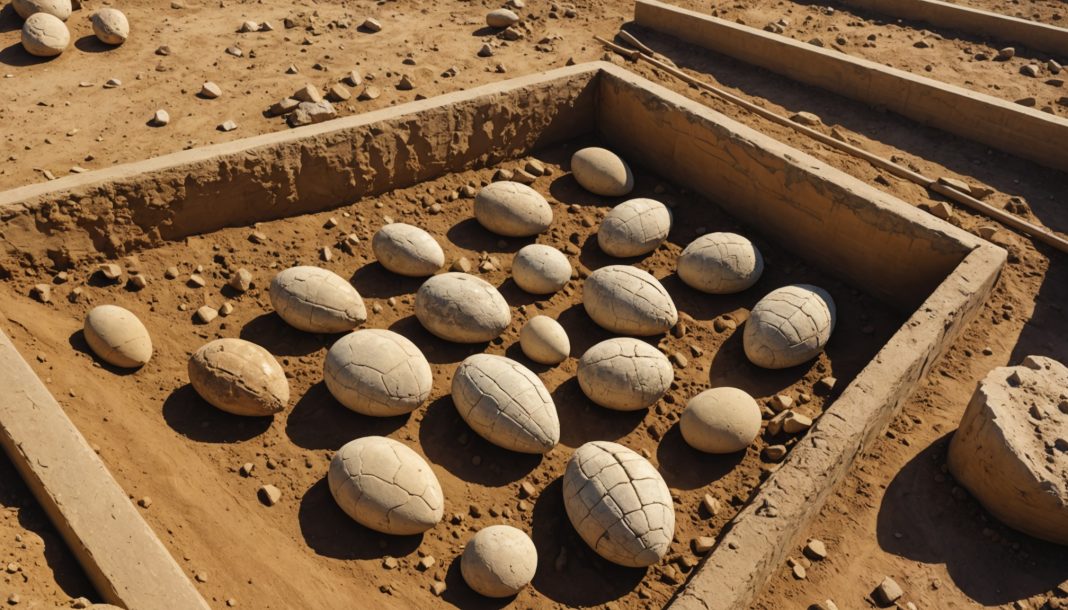
While the Fête de la science (France's annual science festival) is in full swing across the country until October 12, it's a quiet site in the Hérault department that is stealing the spotlight from the booths and lectures organized for the occasion. In Mèze, between Montpellier and Béziers, excavations resumed in October 2025 have just yielded more than a hundred dinosaur eggs 70 million years old, over a surface area of barely forty square meters.
A nesting site used year after year
What strikes researchers isn't just the number of eggs, but their distribution. Teams led by paleontologist Alain Cabot, working with the paleontology laboratory at the University of Montpellier, have identified several superimposed layers of clutches at the same spot. This pattern suggests the site served as a collective breeding ground for several consecutive years, a behavior similar to that of certain colonial birds today, and one still poorly documented among large herbivorous dinosaurs in Europe.
The eggs, most no bigger than a soccer ball, are attributed by several specialists to titanosaurs, gigantic herbivores that could reach fifteen meters in length. Some of the material, however, also points to rhabdodons or other ornithopods known in the region at the same period: precise species identification is still ongoing.
Exceptional preservation thanks to a natural disaster
A paleontological paradox: it was a destructive event that made this remarkable preservation possible. The clutches were quickly covered by fine clay marl, deposited during a sudden flood 70 million years ago. This geological upheaval froze the site, shielding it from erosion and predators and limiting the crushing of the shells: on some nests, the structure has remained almost intact.
About 95% of the shells examined show traces of hatching, proof that most of the eggs reached full term. A few, however, may still contain a fossilized embryo, a prospect that has the University of Montpellier teams excited: analyzing this material could provide unprecedented insight into the embryonic development of these species.
Why this discovery matters for European paleontology
The Mèze site joins a handful of comparable deposits already recorded in southern France, such as the one at Cruzy, also in the Hérault department. But the density of clutches found here — more than a hundred shells over such a small area — makes it, according to paleontologists, one of the richest nesting sites ever documented in Europe. Like other major recent scientific discoveries, it is a reminder that French soil continues to hold major surprises, much like the mysterious structures identified at the edge of Earth's core, revealed just a few weeks ago.
Teams now hope to extend the excavations to clarify the extent of the site and refine the dating of the different clutch layers. This work follows on from other notable advances this year, such as the unprecedented plasma whirlpools observed on the Sun's surface, which likewise shed new light on a natural phenomenon that had until then been poorly understood.
Beyond mere scientific curiosity, this discovery also raises questions about how ancient ecosystems were organized, and sometimes vanished altogether, a topic that resonates with current debates over the pressure being placed on biodiversity today and on natural habitats.
Frequently Asked Questions
Where exactly is the paleontological site located?
It is located in Mèze, in the Hérault department, between Montpellier and Béziers. The site has been known since 1996 and has been regularly excavated for thirty years.
What species do these dinosaur eggs belong to?
Several clues point to titanosaurs, large herbivores, but some of the eggs may belong to other species such as rhabdodons. Precise identification is still being studied by teams at the University of Montpellier.
Why are these eggs so well preserved?
A flood that occurred 70 million years ago quickly buried the clutches under fine clay marl, protecting them from erosion and crushing for millions of years.
Sources
France 3 Occitanie, Futura-Sciences, CNRS Le Journal
This article was written with the help of artificial intelligence. Editorial policy

