


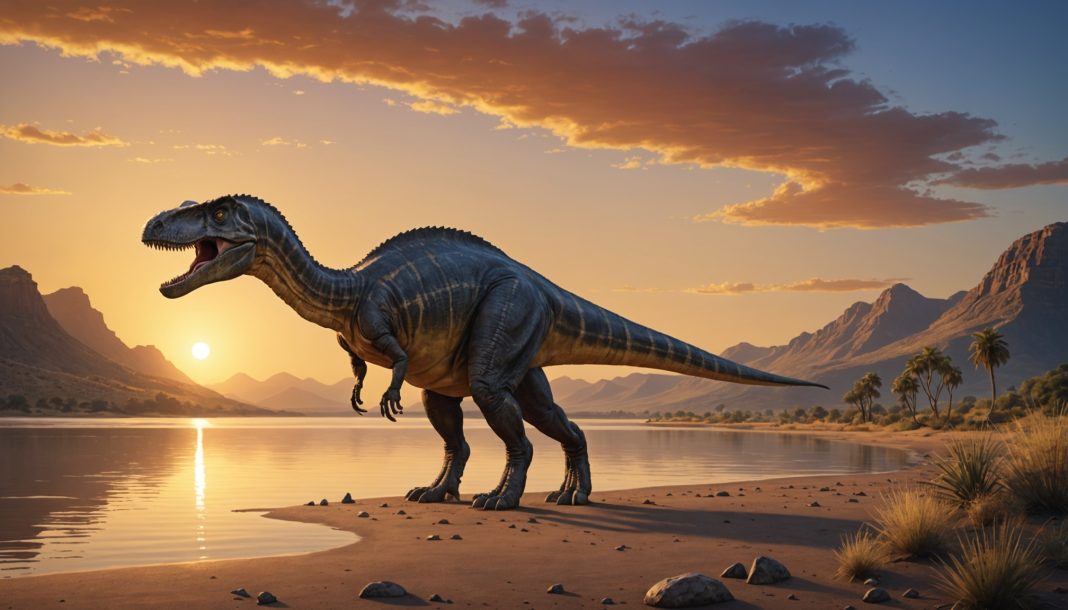
On the shores of Lake Kariba, in Zimbabwe, paleontologists have just described a new species of dinosaur dating back 210 million years. Named Musango matusadonaensis, it adds to a fossil record that remains largely unexplored in southern Africa and challenges some long-held assumptions about the links between the region's prehistoric faunas.
The skeleton was unearthed in 2018 on the lake's shores, in a remote area near Matusadona National Park. It took research teams several years, including scientists from the Natural History Museum in London, to analyze the bones and confirm that this was indeed a new species. The findings were published on July 28, 2026, in the Journal of Systematic Palaeontology.
A Distant Cousin of the Long-Necked Giants
Musango matusadonaensis measured about 4.5 meters long and weighed an estimated 222 kilograms. It belongs to the sauropodomorph group, the lineage that would give rise, millions of years later, to the gigantic long-necked sauropods such as Diplodocus. Unlike its distant descendants, this small Triassic dinosaur walked on its two hind legs rather than on all four limbs.
Its name comes from the Chishona language: “musango” means “one who lives in the bush,” a reference to the remote region where it was discovered, while “matusadonaensis” refers directly to the neighboring national park. It is the fifth dinosaur ever named on Zimbabwean soil.
Two Neighboring but Distinct Species
The discovery is all the more interesting because Musango was found in the same rock formation as another already known dinosaur, Musankwa sanyatiensis. The two animals therefore lived side by side 210 million years ago, but a study of their anatomy, particularly the pelvis and limbs, confirms that they are indeed two distinct species, of different sizes.
This coexistence sheds new light on the diversity of Late Triassic ecosystems in southern Africa. Until now, scientists believed that the faunas of Zimbabwe and those of the Karoo Basin, further south in South Africa and Lesotho, had close biostratigraphic ties. However, no dinosaur species is currently shared between these two regions for this period, which suggests the existence of distinct faunal communities depending on the geographic area.
Why This Discovery Matters
Beyond the paleontological anecdote, this scientific description illustrates just how underexplored the African continent remains in terms of dinosaur fossils, compared to North America or Asia. Each newly identified species helps refine the map of extinct ecosystems and better understand how life spread and diversified before the extinction that paved the way for the golden age of dinosaurs in the Jurassic.
- A new species described 8 years after the skeleton's discovery
- 4.5 meters long, about 222 kg, bipedal
- Distant cousin of giant sauropods like Diplodocus
- Fifth dinosaur named in Zimbabwe
- Coexisted with a neighboring but anatomically distinct species
This kind of work, carried out over a long period from a sometimes incomplete skeleton, also highlights the essential role of international collaboration in paleontology, between local teams and major natural history museums. An unusual travel idea for natural science enthusiasts, who may one day get to see firsthand the landscapes of Lake Kariba that yielded this witness to the past.
Frequently Asked Questions
What is a sauropodomorph?
It is a group of dinosaurs that appeared in the Triassic, ancestors of the giant long-necked sauropods such as Diplodocus or Brachiosaurus. The earliest members, like Musango, were modest in size and often moved on two legs.
Why did this discovery take so long to be published?
The skeleton was unearthed in 2018, but detailed analysis of the bones, comparison with other known species, and the writing of a rigorous scientific description often require several years of work before publication in a peer-reviewed journal.
Is Zimbabwe an important site for paleontology?
It is gradually becoming one: Musango matusadonaensis is only the fifth dinosaur ever named in the country, which shows how underexplored the region remains compared to other parts of the world, and suggests that new discoveries may lie ahead.
Sources
To follow international news more broadly, head to our International News section. Those interested in ecosystems and paleoclimate can also check out our Ecology – Climate section, while anyone dreaming of a getaway to southern Africa will find just what they're looking for in our Travel – Tourism section.
This article was written with the help of artificial intelligence. Editorial policy

