


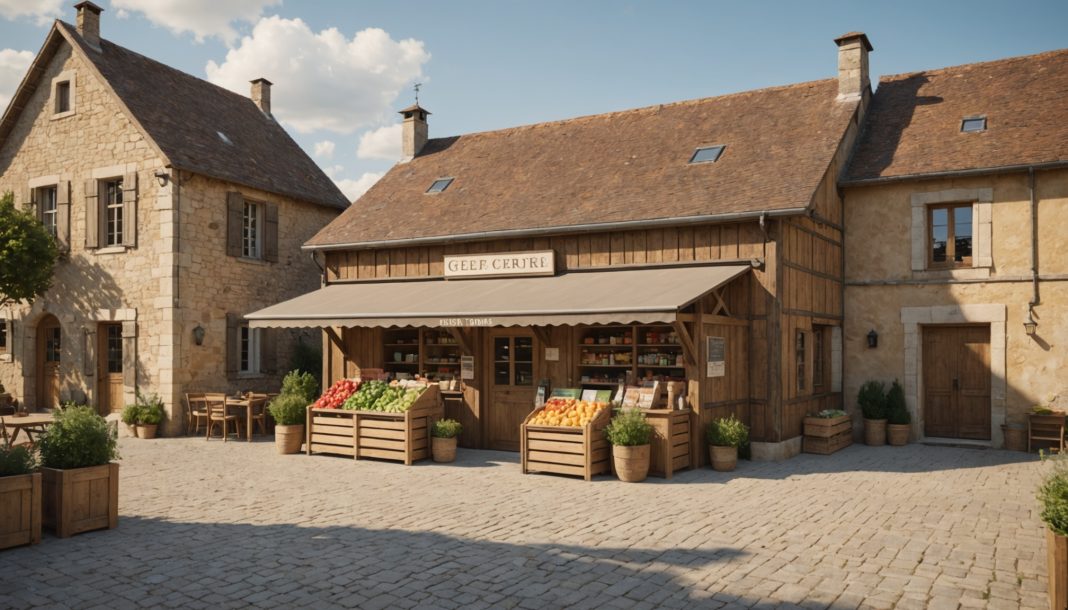
In hundreds of French villages, the lowered shutter of the old grocery store is no longer inevitable. A new format is quietly spreading across village squares: the autonomous convenience store, a small self-service shop open 24 hours a day, with no cashier and no opening hours. Driven notably by the Api chain, this model claims to repair a retail network that has frayed over the past forty years. Here's a look at a trend that is changing daily life in rural France.
A retail desert confirmed by the numbers
The observation is not new, but it has rarely been measured so clearly. According to Insee (the French national statistics institute), more than 21,000 municipalities, or about 62% of them, no longer had any local shop in 2021, compared with only 25% in 1980. In other words, for millions of residents, buying bread, milk, or a cleaning product now means getting in the car.
It is into this gap that automated grocery stores are stepping. The idea: bring back a point of sale where no traditional shopkeeper can survive economically anymore, by cutting fixed costs to the bone through automated access and payment.
How an autonomous convenience store works
The principle is simple. Customers enter the store using their smartphone or a card, shop the aisles, then scan and pay for their purchases at a terminal. No staff at checkout, and the store stays open seven days a week.
- A compact format: wooden modules of about 40 square meters, designed with an eco-friendly approach.
- A tight product range: around 700 food and everyday items — the essentials rather than the full range of a hypermarket.
- Round-the-clock access: open 24/7, suited to odd schedules and unplanned needs.
Unlike a simple vending machine, this format aims to recreate a genuine small grocery store experience, but without the staffing constraints of a traditional shop.
Local jobs despite automation
Automation doesn't mean a complete absence of human involvement. The model relies on a local manager, sometimes called an “apicier,” in charge of restocking, cleanliness, and the relationship with residents. A single manager typically oversees two to four stores in the same area. On this scale, the rollout therefore creates jobs that cannot be outsourced in rural areas — an argument local elected officials regularly highlight.
Expansion accelerating in 2026
The movement is no longer experimental. After a first location opened in Charente in 2023, the network now reports 156 stores spread across 21 departments. For 2026, the chain is preparing to move into two new regions: Auvergne-Rhône-Alpes, with the departments of Ain, Isère, Loire, and Rhône, as well as Hauts-de-France, via Nord, Pas-de-Calais, and Oise.
This momentum is part of a broader context of public support. Under the France Ruralités plan, a dedicated rural retail fund of €19.6 million has supported nearly 1,200 municipalities, confirming that keeping local services alive has become a matter of territorial policy.
Limitations that shouldn't be overlooked
The picture isn't entirely rosy. Industry players themselves admit to having “made mistakes” during the early rollouts. An autonomous convenience store doesn't fully replace the social connection of a shop run by a person, and its economic viability depends on a sufficient flow of customers. Where the population is too sparse, the model can struggle to last. It is therefore one tool among others, to be combined with markets, delivery rounds, and other local services.
Frequently Asked Questions
Is an autonomous convenience store more expensive than a regular supermarket?
The chains emphasize prices comparable to those of major retailers. The stated goal is to prevent rural residents from paying higher prices simply because they lack a nearby store, even though the product range remains more limited than in a large supermarket.
How do you get into the store without any staff?
Entry is through a smartphone app or a dedicated card. Payment is then made self-service at a terminal, which allows the store to stay open 24/7.
Do these stores really create jobs?
Yes, on a modest scale: each area employs a local manager who oversees several stores. It's a local job that cannot be outsourced, even though the number of positions is nowhere near that of a traditional supermarket.
Sources
- franceinfo — Report on unstaffed convenience stores in rural areas
- Banque des Territoires — Rural retail: automated grocery stores on the rise
- Linéaires — Api's 2026 development plan
This article was written with the help of artificial intelligence. Editorial policy

